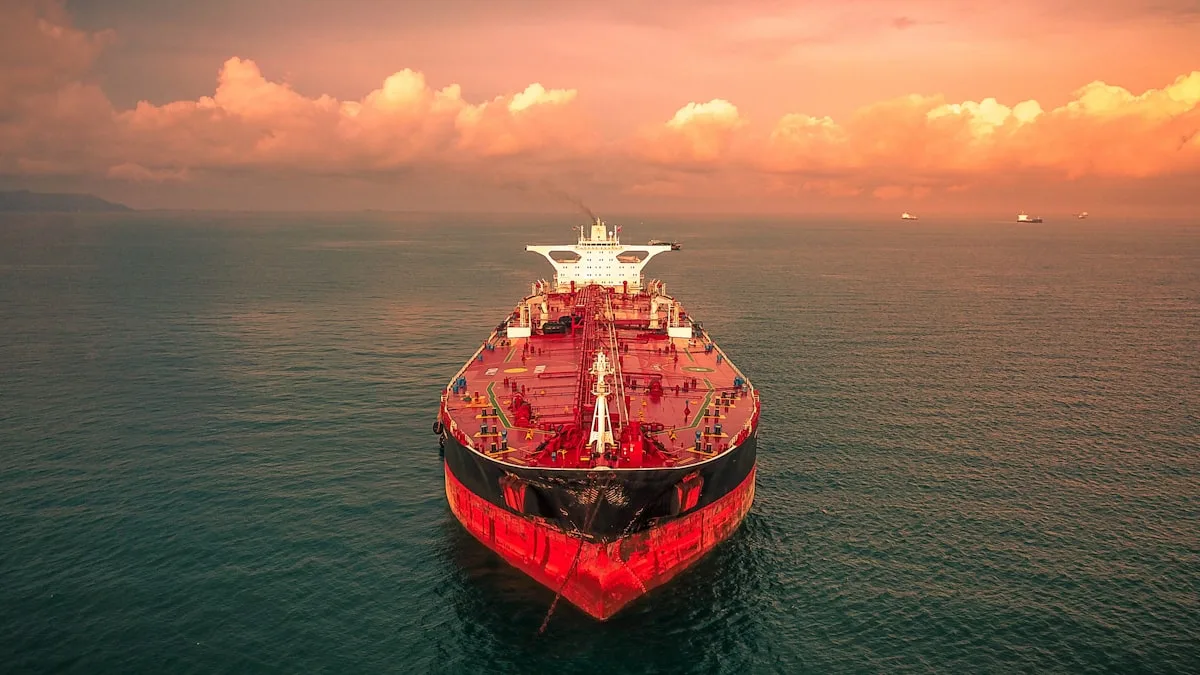
Japan is set to receive its first cargo of crude oil from the Caspian region since the start of the US-Israel-Iran war in late February 2026, with a tanker carrying Azerbaijani crude due to dock at a Japanese refinery on Tuesday, May 12, 2026, the country's Ministry of Economy, Trade and Industry (METI) confirmed to Reuters in a report carried by MarketScreener at 07:17 GMT+3 on Monday, May 11, 2026. The shipment, drawn from the Azeri-Chirag-Gunashli (ACG) producing complex in the Caspian Sea in which Japan's state-backed developer INPEX Corporation (Tokyo Stock Exchange: 1605) holds a participating interest, is the first concrete result of the diversification programme that Industry Minister Ryosei Akazawa announced on April 4, 2026 — a programme designed to bypass the Strait of Hormuz, which Iran has held under effective blockade for more than ten weeks.
Reuters and the Japan Times identified the cargo as having transited via the Baku-Tbilisi-Ceyhan (BTC) pipeline and the Mediterranean Sea — a 25-to-55 day shipping route that is roughly double the 20-day transit a typical Persian Gulf cargo would have taken before the war. The cargo is small in absolute terms relative to Japan's normal four-million-barrel-per-day import programme, but it carries an outsized signalling weight: it is the first physical confirmation that the alternative supply chains Tokyo has been negotiating since March 2026 are actually delivering molecules, not just announcements.
What was announced — and when
The METI confirmation came on Monday, May 11, 2026, with Reuters publishing two consecutive wire takes at 07:17 and 10:21 local time on the Tokyo open. The headline language used by the wire — and adopted by the MarketScreener translation that has been the most-cited English-language version of the story since — describes the cargo as the "first crude oil from Central Asia since the start of the Iran war." That phrasing reflects how Tokyo has been categorising the Caspian basin (including Azerbaijan, which is technically in the South Caucasus) within the broader "Central Asia plus Japan" diplomatic framework adopted by Prime Minister Sanae Takaichi's cabinet in December 2025 — the same framework that has driven the parallel push for Kazakh crude.
The Inter Press Service report from April 2026 had already flagged this framework as the policy infrastructure under which the May 12 arrival is happening: the "Central Asia plus Japan" dialogue, originally launched in 2004, was upgraded in December 2025 to include energy, critical minerals and the Trans-Caspian International Transport Route as explicit pillars. The redirection of INPEX's European spot barrels to Japanese refiners is the first commercial transaction the upgraded framework has produced.
Why "Central Asian" — and whether that's strictly correct
The cargo arriving on Tuesday is Azerbaijani, not Kazakh, and Azerbaijan is geographically a South Caucasus state rather than a member of the five-state grouping (Kazakhstan, Uzbekistan, Turkmenistan, Kyrgyzstan, Tajikistan) that academic geographers conventionally call Central Asia. Both Reuters and METI's official statement, however, have been using "Central Asian" as a shorthand for crude originating in the Caspian basin, and that is the convention this article follows — while flagging that the next Caspian cargo expected in Japan, scheduled by INPEX for late May or early June 2026, is the one that will carry Kazakh Kashagan barrels under the May 4 KazMunayGas agreement and will be Central Asian in the stricter geographical sense.
The Iran war and the Hormuz block
The trigger for the diversification is the US-Israel military campaign against Iran that began in late February 2026, and Iran's retaliatory de facto closure of the Strait of Hormuz — the 21-mile-wide waterway between Iran and the Musandam Peninsula of Oman through which roughly 20% of seaborne crude oil and a quarter of global LNG ordinarily flows. Tehran has not formally declared the strait closed, but mining, missile threats and tanker harassment have together made commercial transit prohibitively expensive: war-risk insurance premiums on Hormuz-routed cargoes have risen by an order of magnitude since the conflict began, and tanker availability has tightened sharply.
For Japan, the disruption is existential at the level of policy: prior to the war, over 90% of Japan's crude oil imports — and The New Voice of Ukraine's May 4 report puts the figure as high as 95% — came from the Middle East, with the overwhelming majority of that volume routed through Hormuz. Japan is the world's fourth-largest crude importer behind China, the United States and India, and the country's refining and petrochemical sectors are structurally configured around the light-to-medium sour grades that Saudi Arabia, the United Arab Emirates and Qatar produce. Cutting that supply off — or even routing it the long way around — is the single largest physical shock to the Japanese economy of the war.
The April 4 plan: where the May 12 arrival fits in
Industry Minister Ryosei Akazawa outlined the diversification programme at a Tokyo news conference on Friday, April 4, 2026, in remarks reported the same day by The Japan Times. The five-track plan: (1) re-source Saudi and UAE crude through Red Sea ports — Yanbu for Saudi Aramco barrels, Fujairah for ADNOC cargoes — bypassing the Strait of Hormuz entirely; (2) bring INPEX's Kazakh Kashagan and Azerbaijani ACG barrels that were normally sold spot into Europe back to Japanese wholesalers; (3) increase imports from North, Central and South America, principally US WTI and Brazilian pre-salt grades; (4) develop additional African sources, with Nigeria, Angola and Egypt named; and (5) release strategic petroleum reserves equivalent to 20 days of consumption beginning in May 2026 to bridge the supply gap during the route transitions.
The Tuesday Azerbaijani arrival is the first physical confirmation that track (2) is operational. Track (3) had its first confirmation on April 24, when Reuters reported that a Cosmo Energy Holdings tanker would dock in Japan on Sunday, April 26 carrying the first US crude cargo to Japan since the conflict began. Tracks (1) and (4) are still in negotiation. Track (5) — the SPR release — began on schedule on May 1.
INPEX's role: the Caspian stakes that made this possible
The reason Japan has Caspian crude to redirect at all is that INPEX, a Tokyo-based exploration-and-production company that is 34%-owned by the Japanese government through the Japan Oil, Gas and Metals National Corporation (JOGMEC), has held meaningful equity in two of the Caspian basin's largest producing assets since the 1990s. Those stakes — and the spot-marketing rights that come with them — are what enabled the company's March 31, 2026 announcement, originally carried by TheJapanNews and recirculated by bne IntelliNews, that it would prioritise selling Kazakh and Azerbaijani barrels into Japan rather than into the European spot market they had historically supplied.
The two assets, as detailed by The Astana Times and INPEX's own project pages:
Kashagan, Kazakhstan — the giant offshore field in the North Caspian Sea, operated by the North Caspian Operating Company (NCOC) consortium with Eni, Shell, ExxonMobil, TotalEnergies, KazMunayGas, CNPC and INPEX as partners; production capacity around 430,000 barrels per day; light-to-medium grade comparable to the Arab Light and Murban baselines Japanese refiners are configured to run.
Azeri-Chirag-Gunashli (ACG), Azerbaijan — the offshore complex south of Baku operated by BP with SOCAR, Chevron, ExxonMobil, Equinor, TPAO, ITOCHU and INPEX as partners; production capacity around 350,000 barrels per day; exported principally via the 1,768-kilometre Baku-Tbilisi-Ceyhan (BTC) pipeline to the Mediterranean port of Ceyhan in Turkey.
Combined, the two fields can produce roughly 780,000 barrels per day, of which INPEX's equity share is a small fraction — but INPEX's spot-marketing allocation, including off-take from joint-venture partners under standard lifting agreements, gives the company a much larger commercial position in the export flow than its equity stake alone would suggest. The barrels arriving in Japan on Tuesday are those spot-marketing allocations being redirected, not new production.
The route: BTC, Ceyhan, the Mediterranean, Suez and the Indian Ocean
The physical route the Tuesday cargo has travelled, as reconstructed from The Astana Times's March 2026 logistical reporting, runs: ACG wellhead → BTC pipeline → Ceyhan terminal on the Mediterranean coast of Turkey → Mediterranean Sea → Suez Canal → Red Sea → Bab el-Mandeb → Indian Ocean → Malacca Strait → East China Sea → Japanese refinery (the specific arrival terminal has not been publicly disclosed, but the cargo will discharge into the network operated by one of ENEOS Holdings, Cosmo Energy or Idemitsu Kosan, the three large Japanese refiners that take INPEX-marketed barrels). The full journey is in the 35-to-50 day window INPEX had originally projected — more than double the 18-to-20 day Hormuz transit a Saudi or Emirati cargo would have taken in normal times.
An alternative route — Cape of Good Hope rather than Suez — has also been used for selected cargoes since April 2026, in part because of concerns about secondary exposure to the Bab el-Mandeb chokepoint and Yemen's Houthi missile activity. That route adds another 10 to 15 days of transit time, pushing total delivery to the 55-day outer bound of the Astana Times range. Whether the Tuesday cargo took Suez or the Cape route has not been disclosed publicly.
Costs: who pays the long-route premium
The longer route has not been free. INPEX's own modelling, reported by bne IntelliNews on March 31, indicated that the Caspian-to-Japan route would carry a materially higher freight cost than Hormuz flows under normal conditions — though one that has been partially offset by the war-risk premium now embedded in the Hormuz route since late February. Industry analysts cited by MarketScreener estimated the all-in additional cost at roughly 3-to-5 US dollars per barrel for Caspian versus pre-war Hormuz flows, though that gap has compressed sharply since March as the Hormuz premium has risen.
Who pays the difference is a separate question. METI's framing has been that the redirection is a commercial arrangement between INPEX and the Japanese refiners, with the Japanese government contributing only via the JOGMEC stake in INPEX itself. In practice, the higher freight costs are expected to flow into refined-product prices at the pump — though Japan's temporary gasoline subsidy programme, in place since March 2026, has been absorbing part of that impact in the retail market.
The KazMunayGas meeting and what's next
While Tuesday's Azerbaijani cargo is the first arrival, Tokyo has been laying parallel groundwork for Kazakh supply. On Monday, May 4, 2026, KazMunayGas chairman Askhat Khassenov met a Japanese delegation led by Parliamentary Vice Minister of Foreign Affairs Arfiya Eri in Astana to discuss supplying Kazakh crude oil to Japan "on mutually beneficial terms," according to KazMunayGas's own press release and follow-up reporting by The New Voice of Ukraine. The talks covered (a) the volumes of Kashagan and CPC Blend (Caspian Pipeline Consortium) crude that could be routed to Japan, (b) geological exploration cooperation, and (c) a potential partnership on methane emissions reduction in Kazakhstan's upstream sector.
Industry watchers expect the first Kazakh-origin cargo — likely CPC Blend lifted at Novorossiysk on the Russian Black Sea coast and routed via the Bosphorus, Suez and Indian Ocean, on the same template as the Korean GS Caltex Nantucket delivery in April 2026 — to arrive in Japan in late May or early June. Kazakhstan has separately said it plans to export 1.5–2.2 million tonnes of Kazakh crude through the BTC pipeline in 2026, with Q1 2026 shipments via that route already reaching 346,000 tonnes according to Report.az.
What it doesn't solve
Newsorga's assessment: the Tuesday Azerbaijani arrival is symbolically important and technically a milestone, but in raw volumetric terms it does not materially change the supply gap Japan faces while Hormuz is closed. The combined Caspian redirection that INPEX is capable of organising — even if all of its Kashagan and ACG spot-marketing allocations are diverted to Japan — is in the low-tens-of-thousands of barrels per day, against an import requirement that is normally above three million. The bulk of the gap is still being filled by (a) the SPR drawdown, (b) Saudi and Emirati cargoes loading at Red Sea ports rather than Persian Gulf ports, and (c) the demand-side reductions that the gasoline subsidy programme has not been able to fully prevent.
What the Caspian flows do solve is a structural problem rather than a volumetric one: they re-establish Japan's presence in the alternative supply chains that the country will need whether or not the Hormuz blockade ends in the next few months, and they validate the commercial case for the "Central Asia plus Japan" framework that Takaichi's cabinet has been building since December 2025. The April 2026 Inter Press Service analysis described this as a generational shift in how Tokyo thinks about its energy security architecture — one in which the Caspian basin moves from a peripheral asset to a strategic one.
Market reaction
Tokyo energy and trading-house equities outperformed the broader Nikkei 225 on the Monday open. INPEX Corporation (1605) closed up +1.58% at JPY 3,848 in the Tuesday session, with MarketScreener consensus from 12 covering analysts still rated OUTPERFORM. ENEOS Holdings (5020) closed up +1.20% at JPY 1,305. Broader market sentiment has also been buoyed by Iran ceasefire optimism — the Nikkei 225 crossed 63,000 for the first time on May 7, 2026, on a combination of strong April corporate earnings and tentative signs of Mideast de-escalation, though Iran has not formally lifted the Hormuz blockade.
What to watch
The next concrete milestones in the diversification programme are: (a) the first Kazakh-origin cargo in late May or early June 2026 under the May 4 KazMunayGas framework; (b) the conclusion of METI's ongoing talks with Saudi Aramco and ADNOC on Red Sea-loaded volumes, which Akazawa described on April 14 as "progressing steadily"; (c) the Q1 2026 earnings release by INPEX on May 13, which will be the first quarter to reflect the Caspian redirection economics; and (d) the next Reuters confirmation, expected in mid-to-late May, of whether the second ACG cargo on this route is actually loading — the test of whether Tuesday's Tuesday arrival is the start of a programme or a one-off optical event.
For now, what Japan has bought itself is a small physical step and a large structural signal: that the "Central Asia plus Japan" framework can move actual barrels across multiple time zones and two continents within four months of being asked to. The Tuesday, May 12, 2026 arrival is the first piece of that proof of concept.