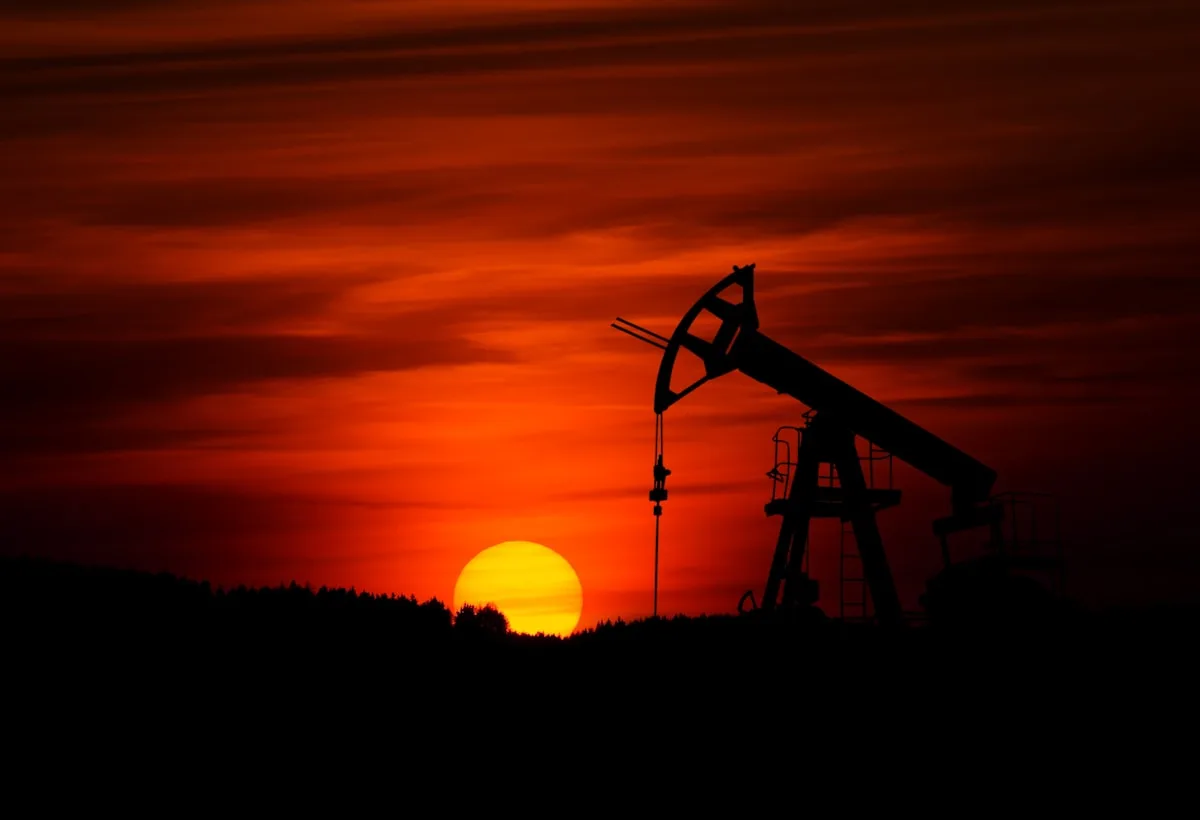
Oil prices opened Monday, May 11, 2026 in Asia with a roughly $3-a-barrel jump after United States president Donald Trump publicly rejected the Iranian written reply to Washington's 14-point peace proposal — a rejection that, combined with the continued near-closure of the Strait of Hormuz to most commercial traffic, removed the last piece of deal optionality the market had been pricing through the previous trading week. Brent crude futures climbed $3.21, or 3.17 percent, to $104.50 a barrel by 22:03 GMT on Sunday, and US West Texas Intermediate (WTI) was at $98.48 a barrel, up $3.06, or 3.21 percent, in the same window — the first opening tick of an Asia–Pacific trading week in which there is no live mediation track and no public claim from either side that one is imminent.
The size of the move is, in dollar terms, modest by the standards of this conflict — but its character is the part that matters. Through the week ending Friday, May 8, both Brent and WTI posted losses of more than six percent because traders were positioning for a deal: a Friday close at $101.29 for Brent and $95.42 for WTI baked in a higher-than-even probability that Iran's reply would be acceptable enough to keep talks going. Monday's $3 reversal is therefore not a fresh shock; it is the unwind of last week's deal-hope premium, with the bid now reflecting renewed pricing of a tail in which Hormuz stays closed, the US naval blockade of Iranian ports tightens, and the Trump administration's public posture moves the diplomatic floor higher rather than lower.
What moved overnight on Monday's Asian open
The headline tape is simple enough: by 22:03 GMT Sunday — the early Monday morning print in Singapore that defines the Asian energy session — Brent had taken back the second half of last week's losses, and WTI had moved almost in step. The proportional move (+3.17% for Brent versus +3.21% for WTI) was unusually symmetric; in earlier weeks of this conflict, the WTI–Brent spread has widened sharply when the news was specifically about Gulf shipping risk, because Brent loads disproportionately reflect Hormuz supply availability. Monday's symmetric move suggests the catalyst was read by traders as a political shock applying to both contracts, rather than a physical shock applying mostly to Brent.
The Reuters dispatch that crystallised the move described the catalyst in operational language: oil prices jumped "as the United States and Iran failed to agree to a peace proposal drafted by Washington while the Strait of Hormuz remained largely closed, keeping global energy supply tight." That phrasing matters because it pairs the political news (the failed agreement) with the structural backdrop (the still-closed strait) — the latter being the variable the price has actually been tracking for weeks. Singapore-time traders went into the open knowing both pieces; the only fresh information on the screen Monday was that Trump's "TOTALLY UNACCEPTABLE!" post had locked the political variable in the higher-risk position rather than the lower-risk one.
Why $3 a barrel almost fully unwound last week's $6 selloff
The clean way to read the move is to back out what last week's selling priced in. Brent fell from roughly $110.60 intraday on May 8 to $101.29 at the Friday close — a loss of more than nine dollars, which the wires attributed to traders positioning for a deal even as Iran fired missiles at the United Arab Emirates twice in the week and the US Navy disabled two empty Iranian tankers (M/T Sea Star III and M/T Sevda) trying to evade the blockade. The Friday print therefore reflected an implicit probability — call it p — that the 14-point proposal would be accepted in enough form to reopen at least part of Hormuz in the near term. Monday's reversal puts p back near where it was before that deal-hope rally began.
What it does not yet do is price a renewed physical deterioration. Brent at $104.50 is well below the $115-a-barrel band the World Bank identified as the upside-risk scenario for a sustained Hormuz closure paired with a broader regional escalation. That gap — about $10 — is, in effect, the cushion the market is still holding back. It will close, fast, if any of three things happens in the next 72 hours: a confirmed Iranian strike on an occupied Western-flag vessel in the Gulf or the Gulf of Oman; a US escalatory move beyond the current blockade (an airstrike on Iranian oil infrastructure rather than tanker disabling); or an explicit Iranian declaration that Hormuz transit will be denied to all tonnage, not just tonnage cooperating with the US blockade.
The Strait of Hormuz: the open-and-shut variable underneath every print
Almost every recent oil-price print since the conflict's February 28 escalation has tracked the same hinge variable: whether the Strait of Hormuz is operationally open, partially open, or closed to commercial transit. Roughly a fifth of seaborne oil and an even larger share of the world's liquefied natural gas (LNG) moves through the strait; when that flow is interrupted, the available barrel count for the global market falls quickly, because the alternative routes (pipeline takeaway from the United Arab Emirates and Saudi Arabia, and onshore storage releases) can only substitute a fraction of the lost volume. The April 8 ceasefire briefly reopened Hormuz to selective transit, but the regime in practice has been a stop-start one ever since, with the US-led merchant-vessel escort suspended after Friday's tanker strikes.
Monday's print is therefore not pricing the strait reopening; it is pricing the strait staying mostly closed for an indeterminate further window. That distinction is the difference between a market that bumps higher when the political news is bad and one that bumps sharply higher: as long as the closure is the operating assumption, each incremental piece of bad political news only moves the price by the marginal change in the duration of the closure traders are pricing — which is why the move is $3 and not $10. The two ways that calculus changes are a clear path to reopening (the strait moves from closed to partially open, knocking prices lower) or a clear path to deeper closure (the strait moves from passively closed to actively contested, knocking prices materially higher).
Jamie Dimon's "skunk at the party" framework, back on the table
JPMorgan chief executive Jamie Dimon's April 6 shareholder letter is the framework most macro desks have been working off through this conflict, and Monday's $3 move puts the central thesis back at the front of the desk-note rotation. Dimon warned of "significant and persistent oil and commodity price shocks" paired with global supply-chain disruption reminiscent of the 2021–2023 episode, with the consequence being "stickier inflation and ultimately higher interest rates than markets currently expect." He called this dynamic "the skunk at the party" for equities in 2026 — language he chose specifically because it conveys that the offset (AI capex, Trump-era tax cuts adding roughly $300 billion and lifting GDP by about 1 percent) is real, but is conditional on the central-bank rate path not getting stuck.
The Monday open is, in Dimon's framework, the kind of event that confirms the skunk is in the room. The price-of-oil channel into headline inflation is mechanical: every $10 sustained move in Brent contributes roughly 0.3 to 0.5 percentage points to global headline inflation over twelve months, with much larger effects in import-dependent emerging markets. With Brent at $104.50 versus a 2025 average closer to $78, the cumulative inflation impulse is already material; another leg toward the World Bank's $115 band would push it past the threshold at which G7 central banks would have to publicly defer the rate-cut paths their 2025 dot plots had assumed. That deferral is the part Dimon was specifically warning about, and it is now back on the table as a concrete possibility rather than a tail.
Equity, currency and rates reaction: what to watch when Europe opens
By the time European stock markets open on Monday morning, the energy complex will have spent six hours pricing the rejection and the broader equity tape will have to follow. The standard playbook is: energy sector outperforms (integrated majors, oilfield-services names, LNG exporters); transport and consumer cyclicals underperform (airlines, road-freight, lower-end retail); defensives and gold hold or rise; and the dollar firms against high-beta emerging-market currencies, especially those of net oil importers. Citi analysts said, in a note circulated last week, that they expect "broader financial markets to stabilize despite recent volatility linked to the Middle East," but flagged that "the path toward normalization is unlikely to be smooth and could keep oil prices elevated in the months ahead."
ANZ Research put the same point in operational terms: "the risk of a proposed U.S. peace deal breaking down will likely keep oil markets volatile." Volatility, not direction, is the trade most desks are now positioned for — long oil-and-energy volatility (via options or volatility-of-volatility instruments), short equity-market complacency (via S&P 500 puts or VIX call structures), and selectively long inflation-linked sovereign debt (TIPS in the US, linkers in the UK and the eurozone). Whether Asian equity benchmarks — the Nikkei, the Hang Seng, the KOSPI — translate Monday's oil move into a clean equity selloff or absorb it into sector rotation will be the first directional signal of how risk-off the week has turned.
How the second-order economy reads this: gasoline, inflation, central-bank doctrine
The transmission from a $104.50 Brent print to the cash economy runs through three channels. The first is retail gasoline: roughly two-thirds of US pump prices and a higher share in Europe is the crude-oil input cost, with the rest being refining margins, fuel-distribution costs and taxes. A sustained $10 move in Brent typically adds 25 to 35 cents to a US gallon over four to six weeks, with European jurisdictions seeing smaller percentage moves because of higher tax floors. The political consequence in the US is direct: the states where gas prices are surging fastest since the war began (visible in price-tracking by industry observers) are also the ones where the Trump administration's domestic energy messaging is being tested in real time.
The second channel is headline inflation running through trimmed-mean and median measures into core expectations. The third — slower, but more consequential — is central-bank doctrine: the Federal Reserve, the European Central Bank and the Bank of England have spent two years walking expected-rate paths lower on the assumption that energy was a deflationary tailwind for late 2025 and 2026. If that tailwind reverses for two consecutive quarters, the language at the next round of policy statements has to change from "we expect inflation to continue normalising" to "we are prepared to pause the rate-cut cycle if energy persistence requires it," and the term-structure of policy expectations re-prices accordingly. That doctrinal shift, if it happens, will move bond markets harder than equities — which is why Dimon's framing puts rates ahead of stocks in his hierarchy of risks.
India's WFH and carpooling signals — the demand side of the shock
The often-missed feature of Iran-war-era oil pricing is that the demand side has begun to respond too, and the signal travels from importer economies first. Over the weekend, Indian prime minister Narendra Modi publicly urged the country's workforce to adopt work-from-home and carpooling patterns to conserve fuel; the call was framed as a national-resilience measure, but it is also a textbook demand-destruction tool the moment retail fuel becomes politically painful. The World Bank's most recent Commodity Markets Outlook has already identified demand destruction spreading from advanced economies into Asia and the Middle East, with a further 1.5 million barrels per day quarter-on-quarter decline forecast for the second quarter of 2026.
Demand destruction matters for the market because it is the lower bound on how high the price can ultimately go. The cleaner an Indian, Chinese, Japanese or South Korean government's pivot toward conservation messaging — and, in policy terms, toward strategic-reserve drawdowns or selective fuel-subsidy maintenance — the harder it becomes for crude to sustain a level the import bill cannot absorb. The two-way pressure (supply-side closure pushing prices up, demand-side adaptation pushing them back down) is why most desks now model a $104–$115 band rather than a single point estimate for Brent over the coming two months. Monday's print sits at the lower end of that band; what would push it toward the upper end is the supply-side variable getting worse, not the demand-side one improving.
What it would take to get oil back below $100 — and what would push it past $115
Two paths back below $100 a barrel for Brent are visible from current pricing. The first is an unwind of the political shock: a credible new mediation channel — most likely Qatar's Sheikh Mohammed bin Abdulrahman al-Thani acting in concert with Pakistan's foreign secretary, after the weekend's Miami track with Steve Witkoff — that produces a public statement from either Washington or Tehran that talks have resumed. The second is a physical unwind: an Iranian-announced Hormuz partial-reopening for non-cooperating tonnage, or a US-announced resumption of the merchant-vessel escort track that was suspended after the May 8 tanker strikes.
Two paths past $115 a barrel are equally visible, and they are the ones the World Bank's upside-risk scenario was built around. The first is a US airstrike on Iranian oil-infrastructure targets (the Isfahan complex, the Kharg Island export terminal, or a known nuclear-related facility); the political signal of moving from blockade to destruction would re-rate the entire risk premium overnight. The second is an Iranian declaration that Hormuz transit is denied to all tonnage, paired with an actual interdiction event (a vessel disabled or destroyed) that demonstrates the declaration has operational teeth. Either path would push Brent through $115 in a single session and force every G7 central bank to issue a revised inflation guidance note within the week. As of 22:03 GMT Sunday, neither has happened — and the price-action gap between $104 and $115 is, exactly, the size of the bet the market is making that neither will.