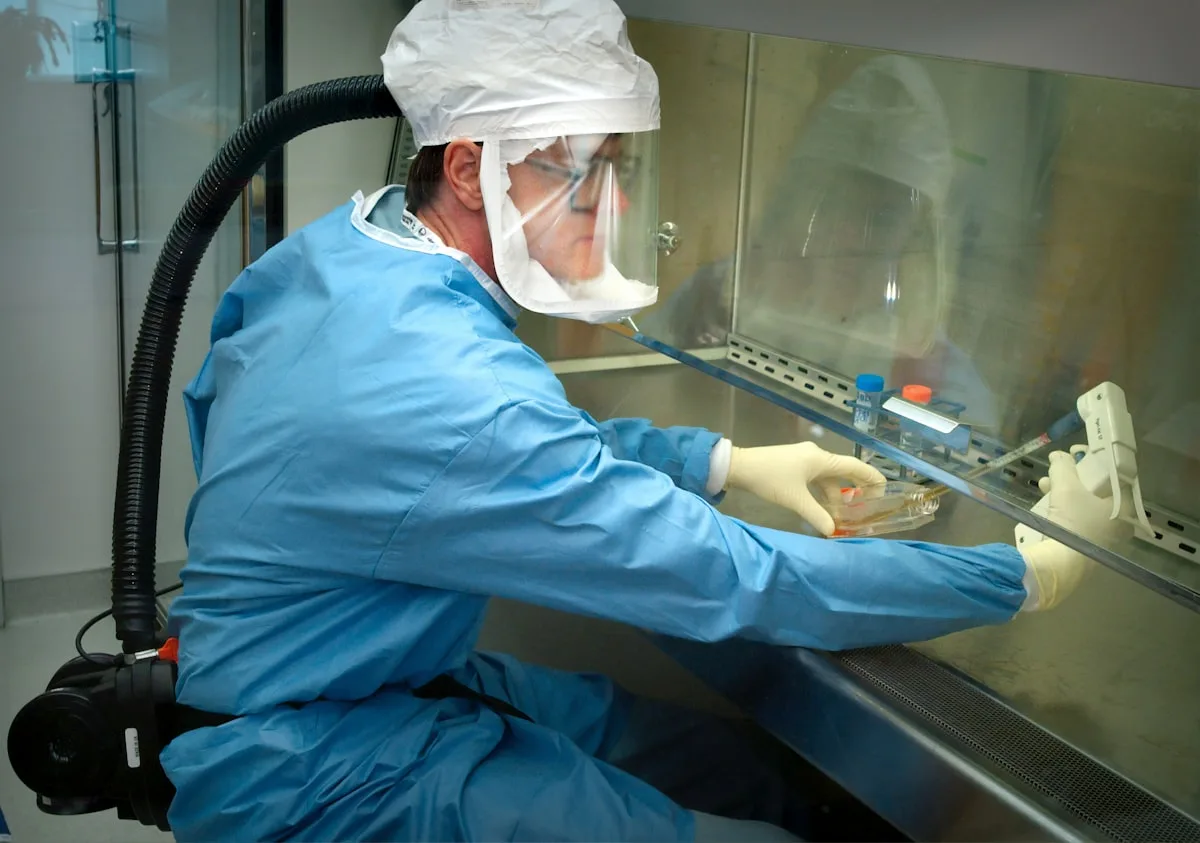
The first of 17 American passengers from the Dutch expedition ship MV Hondius began disembarking at Tenerife on Sunday afternoon, becoming the last major national contingent in the European-coordinated evacuation of the cruise ship at the centre of the 2026 Andes-strain hantavirus outbreak. All 17 will be flown via military aircraft to Offutt Air Force Base in Bellevue, Nebraska, and from there driven to the University of Nebraska Medical Center (UNMC) in Omaha — home to the only federally funded quarantine unit in the United States and the same facility that housed the country's Ebola repatriations in 2014. None of the 17 has tested positive for the Andes strain circulating on the ship.
In a Saturday-morning call with ABC News, the Centers for Disease Control and Prevention disclosed that, unlike France, Spain or Greece, the United States will not impose mandatory quarantine on the returning passengers. Each will be offered a choice between voluntary admission to UNMC's National Quarantine Unit and 42 days of home monitoring under local-health-department supervision, with the 42-day clock starting from each individual's last point of exposure rather than from arrival. Testing is not recommended for any passenger who is asymptomatic, the CDC said — placing the US at the permissive end of a spectrum that, on the same day, has Greece quarantining a single passenger in a negative-pressure room for 45 days regardless of symptoms.
The 17 Americans and Sunday's Tenerife handoff
The American departure is part of a single-day operation that the Spanish health ministry has coordinated out of the port of Granadilla and Tenerife-South airport, beginning with 14 Spanish nationals at 12:55 Paris time and continuing through the afternoon with five French passengers, four Canadians, 22 Britons, two Irish nationals and three Turks. By Sunday evening Madrid time, the 17-strong US contingent — potentially expanded to 19 if two additional individuals are added at the last minute, according to UNMC director Dr. Michael Wadman — was the largest single remaining group, with smaller flights to the Netherlands and Australia still scheduled for Monday afternoon.
Maria Van Kerkhove, the World Health Organization infectious-hazard lead who has briefed the Hondius evacuation publicly since the cluster emerged, described Sunday's transfer protocol in operational detail. 'The plan will be that the ship will anchor and that there will be small boats that will take some of the passengers,' Van Kerkhove said, 'and it will be done in a very choreographed, coordinated way, in a very protected way.' She continued: 'Right now we, as WHO, we classify everybody on board as what we call a high-risk contact. That might sound scary, but it's really how we will operationalise the movement of the passengers and the crew safely home.' The Americans, like every other national group, were transferred via tugboat from the anchored vessel to the port, then bussed under escort to a cordoned-off section of the airport for the medical flight home.
Why Nebraska — the only federally funded quarantine unit in the US
The choice of UNMC is institutional rather than ad-hoc. Omaha's National Quarantine Unit, on the UNMC campus adjacent to the Nebraska Biocontainment Unit, is the only federally funded quarantine unit in the United States, with 20 individual rooms equipped with negative-airflow ventilation and pathogen-grade filters, and staffed entirely by trained volunteers rather than rotated hospital personnel. The facility was built on the operational lessons of the 2014 Ebola repatriations, three of which UNMC handled directly, and the COVID-19 pandemic preparation work that followed.
Dr. Dele Davies, UNMC's interim chancellor, Dr. Angela Hewlett, medical director of the Nebraska Biocontainment Unit, and John Lowe, director of the Global Center for Health Security, held a joint press conference at the UNMC campus on Friday. 'They have been potentially exposed but not shown to have symptoms,' Hewlett said. 'We are ready if one of these individuals develops symptoms with hantavirus.' Lowe added that the centre had been 'in really close coordination and contact throughout the week' with state, federal and international partners. The most consequential point, Wadman noted in passing, is that the quarantine period for the passengers has not yet been defined — a framing that left room for the CDC's Saturday decision to step back from mandatory confinement.
Offutt to Omaha: the operational chain after the flight lands
Under the plan disclosed by UNMC and the CDC, the medical flight from Tenerife will land at Offutt Air Force Base in Bellevue, Nebraska, the same facility that historically handled the Ebola repatriations a decade ago. Passengers will then be driven the roughly 25 kilometres north-east to Omaha and the UNMC campus, where each will receive a health evaluation, and either be admitted to the National Quarantine Unit voluntarily or released to travel onward to their home state for 42 days of active monitoring.
Lowe walked reporters through what the arrival itself will look like. 'They're going to walk off a plane, get in a vehicle and be driven over here,' he said. 'I expect no emergency services will be needed.' Wadman, who manages the National Quarantine Unit day-to-day, said the experience inside is far less ominous than the public conception of quarantine: 'Our facilities have negative airflow rooms and filters to limit the spread of the pathogen. Our people are well-trained… and the most important thing is they are all volunteers.' Davies stressed that those who choose to stay would be 'basically living normal days during their stay.' No CDC personnel will be on-site initially, Lowe said, although he expects them to join the team during the monitoring window.
The "no mandatory quarantine" decision: what the CDC told ABC News
The decisive change in posture came on Saturday morning, when a CDC official told ABC News in a briefing call that none of the 17 Americans had tested positive at the screening point in Tenerife, and that federal officials 'currently do not plan to mandate quarantine when they arrive in Nebraska.' Instead, the official said, passengers would receive health evaluations on landing and *may either stay temporarily at Nebraska's National Quarantine Unit or return home and monitor for symptoms for 42 days while remaining in contact with local health departments. The CDC also said testing is not recommended for passengers without symptoms — the latter detail intentionally aligned with Maria Van Kerkhove's WHO statement that 'the active monitoring and follow-up of all of the passengers and crew who disembark for a 42-day period' is the floor of the protocol, not testing.
The 42-day clock is the operationally important number. Van Kerkhove was explicit: 'That doesn't mean 42 days from now or from tomorrow. It actually means 42 days from the last point of exposure.' For most of the 17, the last point of exposure was disembarkation on Sunday; for the six Americans the Associated Press counted as having left the ship at earlier port stops, the clock is already partly run. Local health departments in the five US states the CDC has been monitoring — Georgia, Texas, Arizona, Virginia and an unspecified number in California, per the agency's situation summary — will track the home-monitoring cohort by phone and text symptom triage until the window closes.
How the US protocol diverges from the European response
Sunday's US choice sits at the permissive end of a spectrum that, on the same day, has Greece at the other. France has placed all five of its evacuees in a 72-hour quarantine at Bichat-Claude-Bernard Hospital in Paris, with 45 days of monitored home isolation thereafter; one of those five developed symptoms on the repatriation flight and is now in a single ward room at Bichat under PCR testing by the Institut Pasteur. Spain has placed its 14 evacuees in the Gómez Ulla military hospital in south-west Madrid, also under monitored isolation. Greece is the strictest of any responding government: a single septuagenarian passenger is being routed via the Royal Netherlands Air Force base at Eindhoven to Athens, where he will spend 45 days in a negative-pressure room regardless of whether he develops symptoms.
The contrast is the cleanest possible illustration of how much interpretive room the WHO's 'low risk to public health' framing leaves to national authorities. Acting CDC director Jay Bhattacharya, who has been the most senior public US voice on the response since the cluster emerged, told CNN on Sunday that each American would be individually risk-stratified, and those judged low-risk would be allowed to travel home 'if their family situation makes it possible to return safely without exposing others on the way.' In effect, the US protocol treats UNMC as an option for those who request it rather than as a destination imposed on the cohort — the inverse of the European posture.
What UNMC's biocontainment leadership is saying
The Nebraska briefings have been notable for the consistency of the 'this is not COVID' message. Dr. Angela Hewlett was the most direct: 'COVID-19 was highly transmissible with a low mortality rate, while hantavirus is not typically known to be transmitted person-to-person… This is not a new virus; this is a virus that has been around for a while. We have not seen sustained human-to-human transmission with hantavirus. I do not see this progressing to a worldwide pandemic.' When asked what would have to be true for the cruise-ship cluster to spread further on land, Hewlett's answer was unambiguous: 'You really need to be up close and personal with somebody' — the standard Andes-lineage transmission framing.
Lowe, who managed UNMC's biocontainment programme through both the 2014 Ebola repatriations and the early COVID period, said the institutional memory of those two events is the reason Sunday's operation will run the way it does. 'It's really helpful to have that background experience and knowing what works,' he told reporters. Wadman added that COVID-19 preparation specifically 'helped with being prepared and focusing attention on what matters.' The implicit message, repeated across the briefings, is that the National Quarantine Unit's value to the United States in 2026 is the option of high-end isolation if any of the 17 develops symptoms — not the assumption that any of them will.
Tom Frieden's "lethal but not a pandemic" framing
The most consequential outside voice in the US framing has been Dr. Tom Frieden, the former CDC director under President Obama, who told WOWT-affiliated reporters in Omaha that the Hondius cluster is unusual but not paradigm-shifting. 'It's not all that surprising to see an outbreak of something that can spread on a cruise ship,' Frieden said. 'On the other hand, what's very concerning is the high case-fatality rate here. This particular strain of the hantavirus, uh, is quite lethal.' Andes-lineage hantavirus pulmonary syndrome has a published case-fatality rate of roughly 30 to 40 percent in symptomatic cases — close to two orders of magnitude higher than influenza or COVID — which is why the WHO classifies the cluster as serious even while declining to treat it as a pandemic precursor.
'Now, that is not to say this is the next pandemic,' Frieden continued. 'Hantavirus is not set up to cause a pandemic the way, say, COVID was at this point, and there's nothing to suggest that it is on the way to doing that.' The Frieden framing — lethal but not pandemic — is the cleanest summary of what Hewlett, Lowe and Bhattacharya have all said in different language. It is also the rhetorical baseline against which the CDC's no-mandatory-quarantine decision should be read: high case-fatality for those who develop symptoms, low base-rate probability that any of the 17 will, and a protocol calibrated to that asymmetry.
The Trump administration's communication so far
Public communication from the Trump administration on the Hondius outbreak has been thinner than on most other foreign-policy stories of the same week. President Trump told reporters on Thursday that his administration 'will soon release more information' on its work to contain hantavirus, without specifying what that information would cover. The most substantive public US statement since has been Bhattacharya's CNN interview on Sunday, which was framed as a reassurance — 'we want to avoid sowing panic' — and which paired the no-mandatory-quarantine decision with an explicit comparison to a 2018 outbreak of 'this exact strain of hantavirus' in South America that the CDC says was 'contained successfully' with a similar protocol.
The five US states the CDC has been monitoring — Georgia (two), Texas (two), Arizona (one), Virginia (one) and an unspecified number in California — have all reported to date that the individuals they are tracking are asymptomatic. None of those state cohorts has been added to the 17 arriving in Nebraska on Sunday; they are being managed separately under local public-health authority. The cleanest open question for Monday is whether the Health and Human Services secretary's office and the White House will issue any further public statement to align the messaging across the federal-state cohort, or whether the response will continue to live primarily inside CDC and UNMC briefing rooms.
What is still aboard the MV Hondius and what comes next
After the US flight departs Tenerife on Sunday evening, roughly 140 passengers and crew members remain to be evacuated, the Associated Press has reported, with smaller flights to the Netherlands, Australia and a remaining contingent of crew still on the docket. The Spanish health ministry has said the last evacuation flight is scheduled for Monday afternoon, after which the MV Hondius will refuel at Santa Cruz de Tenerife and sail to Rotterdam — a journey Oceanwide Expeditions estimates will take roughly five days — carrying only essential remaining crew. The official toll across the entire cluster stands at at least five confirmed Andes-strain infections and three deaths: a Dutch couple and a German national.
For the 17 Americans, the clock that begins on Sunday is functionally the only number that matters: 42 days, with active local-health-department monitoring, until everyone in the cohort either develops symptoms or clears the upper bound of the Andes incubation window. UNMC remains available if any of the 17 changes their mind, and federal officials have said the National Quarantine Unit's 20 rooms will stay staffed and pathogen-ready throughout the monitoring period. The first meaningful test will be the first 72 hours — the window in which most symptomatic conversions from the existing European cohort have occurred — and the cleanest signal of whether the US no-mandatory-quarantine decision was the right one will be whether, by the middle of next week, any of the 17 has needed the Omaha rooms after all.