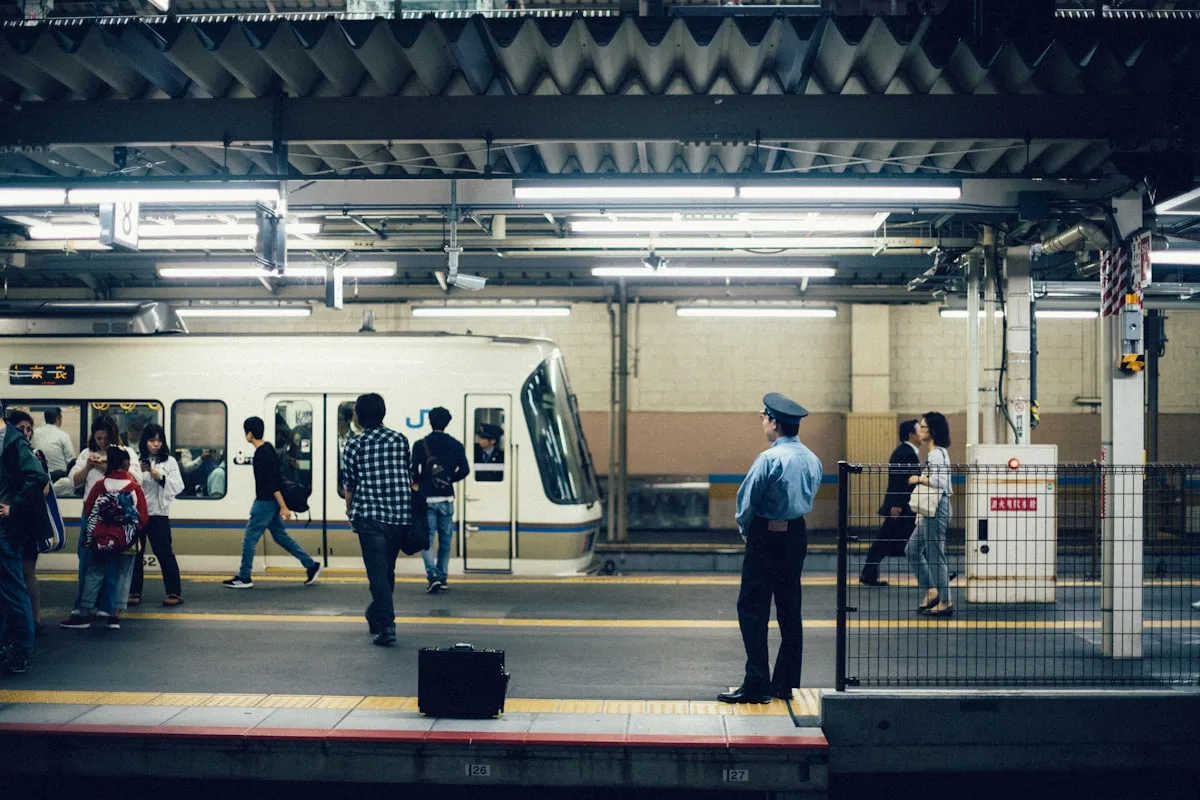
A JR East Tokaido Line up-bound service that left Odawara in Kanagawa Prefecture bound for Takasaki in Gunma Prefecture was brought to a halt at JR Kawasaki Station in Kanagawa on the afternoon of Sunday, May 10, 2026 after passengers told the train crew that an unknown substance had been sprayed inside one of the carriages somewhere between Yokohama and Kawasaki stations at around 16:30 local time. A 35-year-old mother travelling with her husband and their one-year-old daughter said her throat felt irritated; other passengers in the same carriage reported a strange smell. The family of three were taken to hospital, Kanagawa Prefectural Police told local broadcasters; injuries are described as minor and no fatalities have been reported.
More than 20 emergency vehicles — ambulances, fire engines and police cruisers — converged on the Kawasaki platform within minutes of the 119 emergency call, in a response scale that local outlets including TV Asahi, Kyodo News, NHK and the Mainichi Shimbun all noted runs far beyond what three minor injuries alone would normally require. Firefighters who swept the train at the platform said they detected no harmful gas, and police said it was not yet clear whether anything was in fact sprayed; the up-bound Tokaido Line between Yokohama and Shinagawa was suspended with no estimated time for service to resume. JR East passengers were redirected onto the Yokosuka, Keihin-Tohoku and private Keikyu lines that run parallel through the Tokyo–Yokohama corridor.
What was reported: the 16:30 emergency call
The first 119 emergency call went out at approximately 16:30 Japan Standard Time on Sunday, with passengers telling the train crew that 'spray had been released inside the carriage', the wording recorded in NHK's running account. The train had departed Odawara Station earlier in the afternoon — a small mountain-side terminus south-west of Tokyo, roughly 80 kilometres from the capital — on a service that runs the full length of the Tokaido Line into central Tokyo before continuing onto the Shōnan-Shinjuku corridor and ultimately terminating at Takasaki Station in Gunma Prefecture, around 100 kilometres north of Tokyo. The carriage where the substance was reported was somewhere between Yokohama and Kawasaki, the next two stops north of Tokyo's southern entry.
Kanagawa Prefectural Police, who took over the criminal-investigation side of the inquiry within minutes of the call, told reporters at the platform that the 35-year-old mother was the first person to formally describe a symptom — a sore throat. Other passengers in the same carriage reported noticing a strange smell, but the police said it was not yet clear whether anything had actually been sprayed or whether the odour might have come from another source — a discharged personal aerosol, a cleaning product, food, or even a perfume — that triggered the alarm. Mainichi's early dispatch said two passengers were initially described in police-radio traffic as having 'sprayed something', but that wording has not been confirmed in the formal police statement and remains unverified.
The Kawasaki Station response: 20-plus emergency vehicles on the platform
Kawasaki Station is one of the busiest interchanges between Tokyo and Yokohama and sits inside Kawasaki City, a 1.5-million-resident industrial municipality in Kanagawa Prefecture. The platform where the affected train was brought to a stop was cleared of passengers within minutes; Kanagawa Prefectural Police, the Kawasaki Fire Department and the Kanagawa Emergency Medical Service all deployed in numbers that local TV crews counted at more than 20 vehicles. Police taped off the platform, the train doors were opened to the open air to ventilate the carriages, and a portable chemical-detection unit was brought aboard to sample the air inside the affected car.
That portable sweep is the step that produced the most consequential early finding of the afternoon. No harmful gas was detected — the technical wording used in the police readout reported by Kyodo and the Straits Times — and there has been no reading of any of the substances on the Japanese police chemical-attack screen that would automatically escalate the response to a national level. The 20-plus-vehicle deployment is, on its face, calibrated to a worst-case scenario that the on-scene chemistry has now ruled out, but the cordon, the platform closure and the train-clearance procedures will continue until forensic samplers confirm the detector's reading.
The family of three: who was hospitalised
The three people taken from the train to hospital are the 35-year-old mother, her husband and their one-year-old daughter — a family unit travelling together on the up-bound service. The mother is the only one who has been quoted by police as describing a specific symptom (throat irritation); the husband and the infant are listed in the Mainichi early dispatch as having been included in the ambulance run on a precautionary basis given the symptoms described in the same carriage. The classification used in the Japanese police readout is 軽症 (keishō), meaning minor injuries with no requirement for inpatient admission beyond observation.
The hospital that received the family has not been publicly named — standard practice for Japanese police releases when a minor child is involved — and there has been no public statement from the family. Kanagawa Prefectural Police said the observation window will likely run for at least the first 24 hours, during which any delayed onset of respiratory or neurological symptoms would be detected; in chemical-substance protocols, that observation window is the technical reason the family was hospitalised even on minor-injury classification, rather than discharged from the platform.
'No harmful gas detected': what firefighters found
The Kawasaki Fire Department's chemical-screening sweep of the affected carriage produced no positive reading on the on-scene detector, the result that police quoted in the formal afternoon update. That detector profile typically screens for the major classes that Japanese rail-substance protocols cover — organophosphate nerve agents, chlorine and other industrial irritants, ammonia, CS-style irritant sprays and the broader volatile organic compound envelope — and a negative reading across that range is the basis for the police statement that no harmful gas was present at the time of the sweep.
There are two caveats to that finding that the police themselves named at the platform. The first is that a substance dispersed in an open commuter carriage at 16:30, on a train that ran through additional stops before being stopped at Kawasaki, may have dissipated below the detector threshold by the time the sweep was performed. The second is that the question of whether anything was sprayed at all is still open. Forensic sampling of the carriage interior — wipes from seat surfaces, floor and window glass, plus the affected family's clothing — is the test that will produce a definitive answer, and that laboratory work typically takes 24-to-72 hours in Kanagawa Prefectural Police standard turnaround.
The Tokaido line suspension: Yokohama-Shinagawa shutdown
The operational impact ran the full length of the busiest commuter corridor in Japan. JR East suspended up-bound Tokaido Line service between Yokohama and Shinagawa while the affected train was being cleared, the segment that carries the bulk of the Kanagawa-to-central-Tokyo commuter load on Sunday evenings. There was no estimated time for service to resume at the time of the suspension, the wording JR East uses when an incident is open-ended and depends on emergency-services clearance rather than equipment recovery.
Passengers were redirected onto the three parallel lines that run the same Tokyo–Yokohama corridor: the Yokosuka Line (which uses underground platforms at Tokyo Station and runs parallel south of Yokohama), the Keihin-Tohoku Line (which makes additional local stops between Yokohama and central Tokyo) and the private Keikyu Main Line (which runs from Shinagawa to Yokohama on its own right-of-way). Those three lines absorbed the diverted volume with delays but no service suspensions; the Tōkaidō Shinkansen runs on a separate elevated viaduct and was not affected.
Why this story carries Tokyo's 1995 weight: the sarin-attack context
The scale of the 20-plus-vehicle emergency response, the immediate platform cordon, the chemical-detection sweep before re-boarding, and the prompt line suspension are not a generic response to three reported minor injuries. They are the protocol that the Kanagawa Prefectural Police, Tokyo Metropolitan Police and the National Police Agency now apply by default to any substance report on a moving train in the Tokyo metropolitan area, and the protocol was written in the years immediately after the March 1995 Tokyo subway sarin attack in which the Aum Shinrikyo cult released the nerve agent sarin on five rush-hour subway trains, killing 13 people and injuring thousands more.
Japanese rail-security observers writing in the afternoon's coverage made the same point: the response is calibrated for the worst case because the worst case happened. The detector negative does not mean the Aum-era playbook is being abandoned mid-incident — the protocol explicitly runs forensic sampling and a 24-to-72-hour laboratory turnaround even after a negative on-scene reading. That sequence is what produced the Sunday-evening picture of a train cleared, a family observed, a line suspended, and a police inquiry still formally open.
JR East's playbook: how Japanese rail handles substance reports
JR East, formally East Japan Railway Company, runs more than 12,000 passenger trains a day and the Tokaido Line is one of its highest-volume commuter routes. The company's published incident-response playbook for substance reports specifies the precise sequence that played out on Sunday: immediate stop at the nearest station with police-and-fire coverage, full carriage evacuation to the platform, decoupling of the affected coach where practicable, a chemical-detection sweep before any movement of the train, forensic-grade sampling of the carriage interior, and suspension of the affected line segment until the on-scene incident commander signs off.
What the playbook does not specify, in the version JR East publicly publishes, is when a line can be re-opened in the case of a negative on-scene reading combined with an open police inquiry. That decision is delegated to the incident commander on the ground, working in real time with the Kanagawa Prefectural Police lead. As of the latest update on Sunday evening, that decision had not been made publicly and the up-bound Yokohama-Shinagawa segment remained suspended.
The investigation: what we know police are doing next
Kanagawa Prefectural Police are running the criminal-investigation side, with the Kawasaki Fire Department handling the hazardous-substances and decontamination side and Kanagawa Emergency Medical Service continuing to monitor the hospitalised family. Police told reporters at the platform that the inquiry is open on the question of whether anything was sprayed and, separately, on what substance if so. The forensic sampling of the carriage and the family's clothing — the laboratory work that will produce a definitive yes-or-no on whether a substance was released — is expected to run for between 24 and 72 hours in standard Kanagawa Prefectural Police turnaround.
If the laboratory work returns a positive identification of a substance, the inquiry will escalate to whether the dispersal was accidental, a minor public-nuisance act (the most common cause of substance reports on Japanese trains, typically a discharged personal-defence spray or an aerosol can), or a deliberate act. The early on-scene indicators — minor injuries, negative on-scene gas reading, no claims of responsibility — point in the direction of the first two possibilities. The investigation has not been escalated to the National Police Agency's anti-terror division at this stage, the indication police gave on Sunday afternoon.
What we don't yet know: the unresolved questions
Three substantial questions remain open at the time of writing on Sunday evening. The first is whether anything was actually sprayed at all, or whether the strange-smell report and the throat-irritation symptom were prompted by a different source — a question that turns on the forensic-laboratory results expected in the next 24-to-72 hours. The second is the identity of any person who might have released a substance: police have not described a suspect, made any arrest, or said whether any closed-circuit television footage from the affected carriage shows a relevant person of interest. The third is the resumption time for the up-bound Yokohama-Shinagawa segment, which JR East has not yet estimated publicly.
Newsorga will update this story as Kanagawa Prefectural Police, the Kawasaki Fire Department and JR East issue their next round of statements. Readers in the Kanagawa-Tokyo corridor on Sunday evening are advised to consult JR East's official line-status feed for the latest service information; the affected family is, at the time of writing, in observation with minor injuries and no reported deterioration.