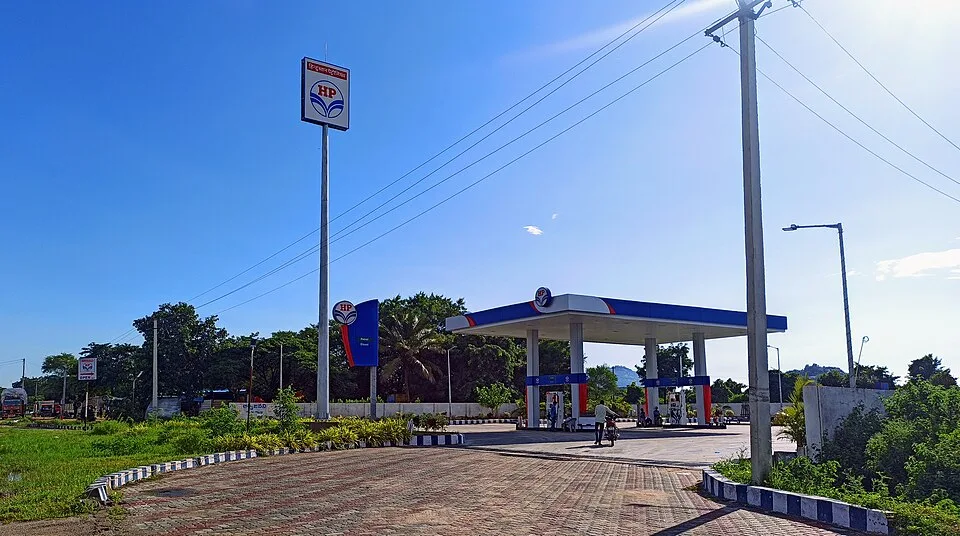
For roughly two years, retail petrol and diesel on most public pumps in India moved little—a political compact as much as a pricing formula. May 2026 stressed that arrangement: Middle East disruptions helped drive international benchmarks from roughly $70/barrel territory cited for February toward bandied peaks around $114–126, while reporting on Indian refiners pointed to average crude acquisition near $105.4 (reported). The state-owned oil marketing companies (OMCs)—Indian Oil (IOCL), Bharat Petroleum (BPCL) and Hindustan Petroleum (HPCL)—bore much of the delta so boards at street level still showed familiar maximum retail prices.
That absorption has a ledger. Wire and business-desk reporting attributed to the three firms combined under-recoveries of about ₹1,600 crore to ₹1,700 crore a day, more than ₹1 lakh crore over about ten weeks and roughly ₹30,000 crore a month at the quoted run-rate (reported). Policymakers must choose who carries the next slice of the shock: shareholders, lenders, and public-sector balance sheets—or motorists, truckers and farmers through higher MRPs and knock-on costs.
How the losses stack up
Under-recovery, in plain terms, is the gap between what it economically costs to land molecules at a pump—crude, refining, marketing, freight, margins and tax handles—and the retail price the system tolerates once elections, inflation politics and social expectations lean on the dial. When global product curves jump and visible Indian retail numbers stay flat, the OMCs fund the difference across enormous volumes.
The table below summarises magnitudes that The Times of India, PTI-sourced copy and allied business pages were carrying in early May; treat every cell as reported industry and official colour, not audited results:
| Indicator | Order of magnitude (reported) |
|---|---|
| Combined daily under-recovery (IOCL, BPCL, HPCL) | ₹1,600–₹1,700 crore |
| Losses over ~10 weeks | More than ₹1 lakh crore |
| Implied monthly pace | ~₹30,000 crore |
| Crude context | ~$70/bbl (Feb) toward $114–126 peaks cited in coverage |
| Indian refiners’ crude cost (May context) | ~$105.4/bbl |
Why the Middle East arc hit India’s import bill
India imports the lion’s share of its crude; price spikes transmit quickly through term and spot cargoes, freight, insurance and working-capital lines. ToI’s summary of the crisis impact pointed to roughly 40% of India’s crude imports, 90% of LPG and 65% of natural gas imports sitting in the disrupted lane (reported). Those shares are best read as scale indicators of exposure, not precision engineering: any sustained choke reroutes barrels, reprices risk and stretches inventory policy for refiners that must keep 24/7 units fed.
Three additional compressions landed at once on marketer margins: dollar invoices against a rupee that only partly offsets, volatile crack spreads for transport fuels abroad, and domestic retail politics that froze the visible pump number while world markets gyrated. Cutting Centre excise (next section) bought fiscal space for consumers; it did not shrink the cost of crude futures abroad.
The excise cushion—and why it cannot repeat every quarter
New Delhi had already leaned hard on Union excise as the shock absorber. Reporting described petrol duty falling from ₹13/litre to ₹3/litre and the ₹10/litre diesel levy being zeroed in the cited tranche—relief the same articles translated into about ₹14,000 crore a month in forgone central revenue at the time of the estimate (reported). That trade is explicit: protect pumps today, collect less excise tomorrow—or borrow elsewhere.
| Excise move (reported) | Before → after (Centre) |
|---|---|
| Petrol | ₹13 → ₹3 per litre |
| Diesel | ₹10 → ₹0 per litre |
| Revenue hole cited | ~₹14,000 crore/month |
Sujata Sharma, joint secretary in the petroleum ministry, said the aim had been to avoid increases so far, while stopping short of confirming imminent hikes (reported). Other officials, quoted without full attribution in the same news cycle, were blunter: with duties near the floor, prolonging the “absorb at the company” model bleeds capital expenditure pipelines and working capital for entities that must keep buying crude in dollars (reported).
Pumps still frozen—while expectations move
Despite the balance-sheet pressure, retail tariffs cited in press roundups remained static into early May: Delhi at ₹94.77/litre petrol and ₹87.67/litre diesel; Mumbai higher because of state VAT layers—₹103.54 and ₹90.03 respectively (reported). Household LPG, even after a ₹60 cylinder nudge in March, was still described as below parity with import-parity economics (reported).
| Early May MRPs (reported) | Petrol | Diesel |
|---|---|---|
| Delhi | ₹94.77/L | ₹87.67/L |
| Mumbai | ₹103.54/L | ₹90.03/L |
Reporting, not a cabinet order, framed the likely next step as ₹4–5/litre increases on petrol and diesel before 15 May, with ₹40–50 more on a subsidised LPG cylinder should clearance come (reported). Timing stays a political decision; the economic pressure is that marketers need room to fund operations without perennial loss carry that starves maintenance and crude procurement.
Beyond the forecourt: diesel, trucks and the inflation chain
Diesel powers long-distance freight, farm tubewells, buses and backup gensets; petrol skews to urban mobility and two-wheelers. A durable reset in diesel feeds into distributed logistics costs before it registers as a clean line in CPI releases; petrol moves hit discretionary commuter budgets immediately. Together they shape felt inflation even when core baskets look composed.
For RBI watchers and bond desks, the operative question is whether passthrough is a one-off level shift or the start of second-round margin chasing in services and wholesale trade. That hinges on how long Brent-linked economics stay elevated and whether New Delhi reaches again for duty tweaks, direct transfers or quasi-fiscal channels to soften edges—topics circulating in commentariat copy, not settled in official gazettes (reported speculation).
Signals to track after the first hike
Three readings will clarify whether the market has fully digested the shock:
OMC daily loss tallies—do they compress once retail catches international reality?
State tax behaviour—do VAT rates hold, magnifying north–south pump gaps?
LPG timing—does the politically sensitive cylinder move with transport fuels or on a slower track?
Until notification text appears, treat the figures here as reported desk copy tied to the URLs in referenceArticle and additionalMaterials, not a promise of midnight price boards.