The Milken Institute released its 2026 Global Opportunity Index (GOI) on April 7, 2026 from Washington, D.C., naming Malaysia (23rd globally), Vietnam (39th), Indonesia and the Philippines as the leading investment destinations among Southeast Asia's developing economies, with Singapore sitting separately at 7th in the world—excluded from the regional growth-market group but still benchmarked in the index. Across the six Southeast Asian growth markets covered in the 2026 wave, foreign capital inflows accounted for 8.2 percent of all money flowing into emerging and developing economies between 2021 and 2024, and foreign direct investment (FDI) delivered more than 70 percent of the regional total.
The report frames Southeast Asia as the single biggest beneficiary of corporate supply-chain diversification away from China, but it also makes a sharper point: investors are now selective rather than wholesale. Macroeconomic stability, the depth of domestic financial systems and the quality of institutional frameworks now separate winners (Malaysia, Vietnam, Singapore, Indonesia) from countries that posted attractive headline growth but missed on governance metrics (Philippines, Cambodia, Laos). The 2026 release is built from 101 variables across five categories, drawing on data from the World Bank, International Monetary Fund, United Nations and Transparency International.
The Southeast Asia focus and why it matters now
Each annual GOI release picks a regional theme. The 2026 edition—subtitled Growth Markets in Southeast Asia—lands at a moment when global investors are rerouting capital out of China, into ASEAN, and increasingly into a small set of countries with the institutional capacity to absorb it. The 8.2 percent share of all emerging-and-developing-economy capital inflows captured by the region between 2021 and 2024 understates the underlying signal, because the share excludes Singapore and Brunei, both of which the index treats as developed economies.
FDI dominance is the structural anchor. When more than 70 percent of inflows to a region come as direct investment rather than portfolio money, the capital is stickier, harder to pull out in a crisis, and more closely tied to physical assets—factories, logistics, semiconductor packaging, electric-vehicle supply chains. That mix is what makes Southeast Asia a credible long-term home for manufacturing capital that previously sat in coastal China, and it is what the Milken authors mean when they describe the region as displaying "calibrated growth amidst global headwinds."
Who publishes the Global Opportunity Index
The Global Opportunity Index is an annual product of the Milken Institute, a nonpartisan, nonprofit think tank founded in 1991 by financier Michael Milken and now headquartered in Santa Monica, California, with major offices in Washington, D.C., London and Singapore. The institute is best known for the Milken Institute Global Conference, the Asia Summit and the Global Investors' Symposium, and its research division publishes capital-markets indices intended to give investors and policymakers comparable cross-country data outside the standard sovereign-rating ecosystem.
The 2026 GOI is authored by Maggie Switek (lead author and director of research for the index), Leilani Jimenez, Nathan Jefferson and Matthew Aleshire, with Laura Deal Lacey signing off as executive vice president for international. Aleshire, the institute's director of geo-economics, framed the central message in the release: investors are seeing a continued shift in global capital toward high-growth emerging markets, and Southeast Asia is a key beneficiary—but countries that fail to maintain macroeconomic stability, deepen their financial systems and strengthen governance will not capture it.
How the index is built
The GOI evaluates investment opportunities using 101 variables organised into five major categories and 14 subcategories. The categories are Business Perception, Economic Fundamentals, Financial Services, Institutional Framework and International Standards and Policy. The variables measure economic openness and performance, business constraints, workforce talent and diversity, regulatory quality, contract enforcement, capital-market depth and—new for the 2026 wave—the quality and reach of each country's digital infrastructure and technology adoption.
Underlying data come from the World Bank, the International Monetary Fund, the United Nations, Transparency International and the World Bank's Business Ready project, the successor to the discontinued Doing Business survey. That mix of sources is the index's strongest methodological claim: scores do not rest on any single survey instrument, and changes between waves can be tracked back to individual indicators within categories. The trade-off is the standard one for composite indices—weighting decisions are the publisher's, and shifts in underlying methodology can move a country's rank without any change in the country itself.
Malaysia at 23rd: what is driving the regional lead
Malaysia ranks 23rd globally in the 2026 GOI, the highest position of any developing Southeast Asian economy and a placement that the Milken authors attribute to strong institutions and robust economic fundamentals rather than to any single growth burst. Malaysia ranks 17th in Financial Services—its strongest pillar—and 18th in Business Perception, putting it ahead of every other ASEAN country except Singapore on the perception variable that measures how cross-border investors actually rate the operating environment.
The Malaysian profile is a useful illustration of why composite indices matter. The country's headline GDP growth has been steady rather than spectacular, and yet it converts that growth into investor appetite better than faster-expanding regional peers because of three pillars the index measures explicitly: a well-capitalised banking system, deeper capital markets than most ASEAN states, and an anti-corruption framework that—while not Singapore-grade—performs visibly better than Indonesia's, the Philippines' or Vietnam's on Transparency International inputs.
Vietnam's 7.1 percent growth and the 39th rank
Vietnam is the 2026 release's growth story. The country posted 7.1 percent real GDP growth in 2024, the fastest of any market in the developing Southeast Asia group, and ranks 2nd in Economic Performance globally on the GOI's component score. It places 14th in Financial Size and Conditions, reflecting a rapidly deepening domestic financial sector that has absorbed a sustained wave of FDI into electronics, textile and semiconductor-packaging supply chains.
Where Vietnam still loses ground is on the perception side. The 39th global rank reflects ongoing investor concerns about contract enforcement, anti-corruption progress and the regulatory environment for non-state firms, the same friction points that have appeared in every Milken release on Vietnam since the index was launched. The Milken authors' implicit message: Vietnam's economic engine is strong enough to overcome those frictions for capital that is already inside the country, but new entrants weighing Vietnam against Malaysia, Thailand or Indonesia continue to discount perceived institutional risk.
Indonesia's 40-place financial-sector jump
Indonesia, the region's largest economy and Southeast Asia's most populous market, registered the single biggest movement of any country in the 2026 release. Its Financial Services ranking jumped from 78th globally in 2022 to 38th in 2026—a forty-place gain in four years—driven by an even bigger gain on Financial Access, where Indonesia now sits at 28th in the world. That progress reflects the post-2021 expansion of digital-banking infrastructure, the consolidation of state-owned banks and a regulatory push to bring small-and-medium enterprises into the formal financial system.
Indonesia's broader profile is uneven by design. It punches above its income on opportunities the index measures—as the institute's own 2024 brief titled "Indonesia: The World's Best-Kept Investment Secret?" argued—but it still trails Malaysia on perception and institutional metrics, which is why the country has not closed the rank gap with Kuala Lumpur despite a far larger absolute economy and a younger demographic profile. The 2026 wave records the financial-sector progress without claiming that the underlying governance gap has been resolved.
The Philippines: a 6th-place economic engine running into governance friction
The Philippines is the index's most pointed split-screen story. The country ranks 6th globally in Economic Performance, supported by 5.7 percent projected GDP growth for 2026 and strong post-pandemic recovery momentum across services, business-process outsourcing and remittance-driven consumption. Few emerging economies in the world post a higher Economic Performance score in the 2026 release.
And yet the country ranks 56th in Business Perception and 59th in Institutional Framework globally—gaps so wide that the Milken authors call them out directly as a constraint on long-term investment prospects. Persistent concerns include the regulatory environment for foreign equity ownership in strategic sectors, contract-enforcement timelines, the anti-corruption record under successive administrations and the 2025-2026 political backdrop around the Marcos-Duterte realignment. The composite consequence is that the Philippines captures less FDI than its growth rate alone would predict, and that 2026 inflows still trail those of Malaysia and Vietnam in absolute terms.
Cambodia and Laos: institutional gaps weighing on inflows
Cambodia and Laos sit at the bottom of the Southeast Asia growth-market group in the 2026 GOI, with the Milken authors flagging persistent institutional weaknesses that constrain their investment environments. Both countries underperform on the Institutional Framework and International Standards and Policy pillars; both also face concentration risk in their FDI mix, with Chinese capital dominating to a degree that raises diversification questions for the Milken index's sub-categories on investment partner diversity.
For Laos specifically, sovereign-debt concerns and currency stress over the 2024-2025 period further depress the composite score; for Cambodia, the 2026 release flags ongoing reform gaps in financial-services regulation, although digital-payments adoption is one bright spot inside the Financial Access sub-score. Both countries are likely to remain net niche destinations for global capital—attractive on labour costs, less attractive on the institutional pillars that anchor the rest of the GOI framework.
Singapore as the regional anchor at 7th globally
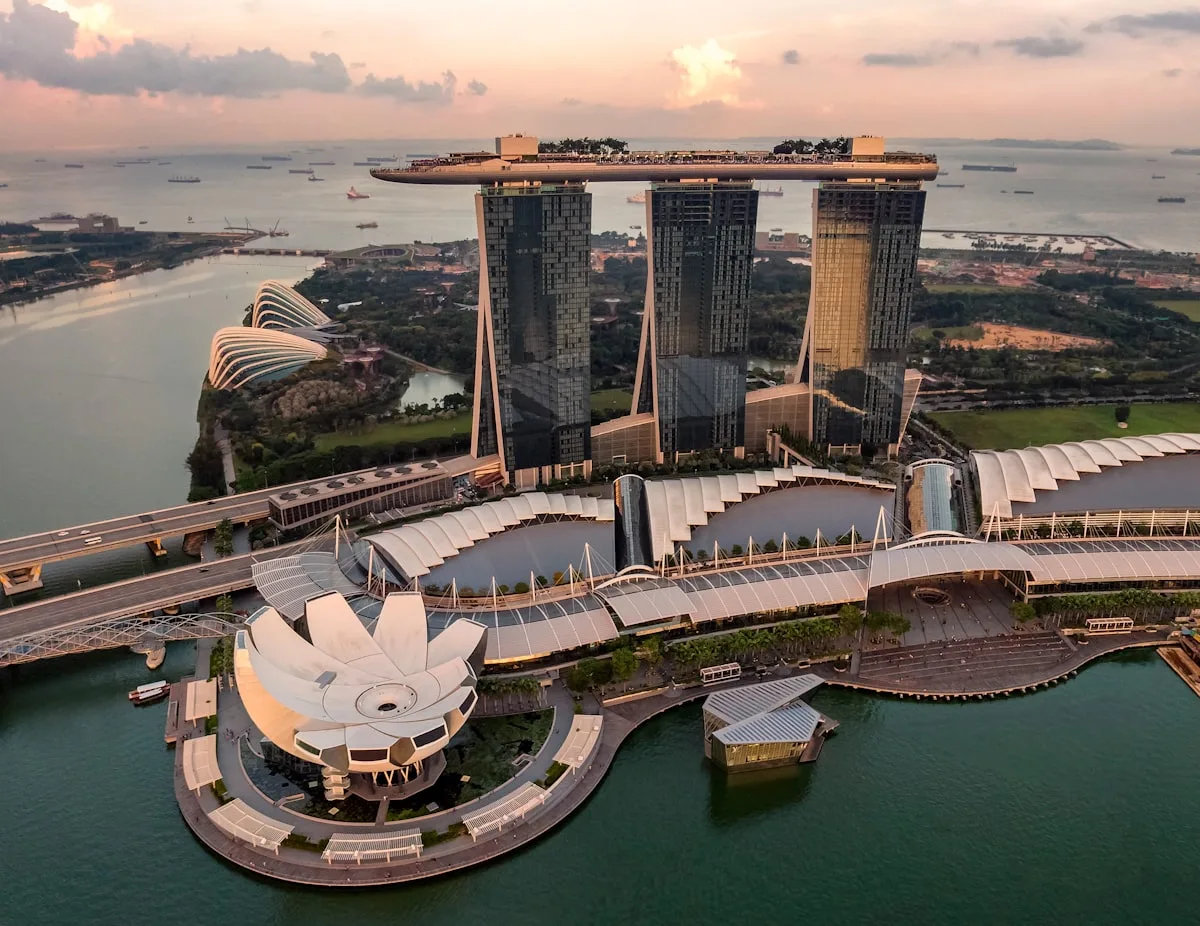
Although Singapore is excluded from the developing Southeast Asia group because of its status as a developed economy, the index continues to rank it on the same 101-variable scale, and the 2026 release places the city-state at 7th in the world. Singapore ranks 3rd globally in Financial Size and Conditions, 11th in Financial Access, 4th in Business Perception, and 4th in International Standards and Policy—a near-clean sweep across the categories where the rest of the region still has visible gaps.
The presence of Singapore at the top of the table matters strategically for the rest of the region, because the city-state is the financial-services hub through which a large share of the FDI flowing into Malaysia, Vietnam, Indonesia and the Philippines is structured, booked or routed. Capital landing in Vietnamese semiconductor packaging or Indonesian battery-precursor projects typically passes through a Singapore-based holding vehicle, which is why the Milken authors describe Singapore as the regional anchor even when the developing-market analysis treats it separately.
What changed in the 2026 methodology
Two methodological revisions matter for cross-year comparison. First, the 2026 GOI incorporates data from the World Bank's Business Ready project, which replaced the discontinued Doing Business survey in 2024 and provides a new baseline for regulatory-environment indicators. Some rank changes between the 2024 and 2026 waves of the GOI therefore reflect the underlying source switch as much as actual country movement, and readers should treat single-year jumps with appropriate caution until the new series stabilises.
Second, the 2026 release expands coverage of the digital economy, capturing both the quality and the extent of countries' digital infrastructure and technology-adoption rates. That update favours countries that have made measurable progress on digital-payments penetration, fixed-broadband coverage and digital-government services—a list that includes Indonesia (whose Financial Access jump partly reflects digital-banking penetration), Vietnam and Malaysia. The 2026 methodology refresh is one reason Indonesia in particular shows such large gains relative to the 2022 baseline.
What investors take from the 2026 wave
Two senior Milken voices framed the headline takeaways. Matthew Aleshire, director of geo-economics and a report author, said the region's growth story "remains compelling, but investors are becoming increasingly selective"—a clear statement that the 2020-2024 wave of indiscriminate ASEAN enthusiasm has ended, and that capital is now sorting countries by institutional quality. Laura Deal Lacey, executive vice president for international, framed the 2026 release as a tool to help "decision-makers and policymakers ... craft resilient investment strategies that harness Southeast Asia's considerable untapped potential."
For allocators reading the index, three operational signals stand out. First, the cross-category gap between Malaysia and the Philippines—similar growth rates, very different institutional rankings—shows up directly in the composite scores and translates into different long-run FDI ceilings. Second, Indonesia's financial-services jump suggests that sector-specific rank gains can outpace overall composite movement, and capital looking at Indonesian banking, payments or capital-markets exposure should weight the 38th-place Financial Services rank more heavily than the headline country score. Third, the prominence of supply-chain diversification language across the 2026 release signals that the "China-plus-one" thesis is now embedded in the Milken view of how capital reroutes through the rest of the decade.
Bottom line
The 2026 Global Opportunity Index, published on April 7, 2026 by the Milken Institute and authored by Maggie Switek, Leilani Jimenez, Nathan Jefferson and Matthew Aleshire, ranks Singapore 7th in the world and Malaysia 23rd—the highest of any developing Southeast Asian economy—with Vietnam at 39th and Indonesia showing the single biggest improvement of any country, climbing from 78th to 38th on Financial Services in four years. Across the region's six growth markets, 8.2 percent of all capital flowing into emerging and developing economies between 2021 and 2024 went to Southeast Asia, with FDI delivering over 70 percent of the inflow mix.
The 2026 takeaway is selection, not euphoria. The index records strong economic-performance scores for the Philippines (6th) and Vietnam (2nd) but also flags 56th- and 59th-place Business Perception and Institutional Framework rankings that constrain the Philippine FDI ceiling, and similar friction inside Vietnam's perception scores. Cambodia and Laos remain at the bottom of the regional group on institutional metrics. For global investors, the 2026 GOI reads less as a celebration of ASEAN and more as a map of which Southeast Asian governments have converted growth into investor-grade institutions—and which have not.