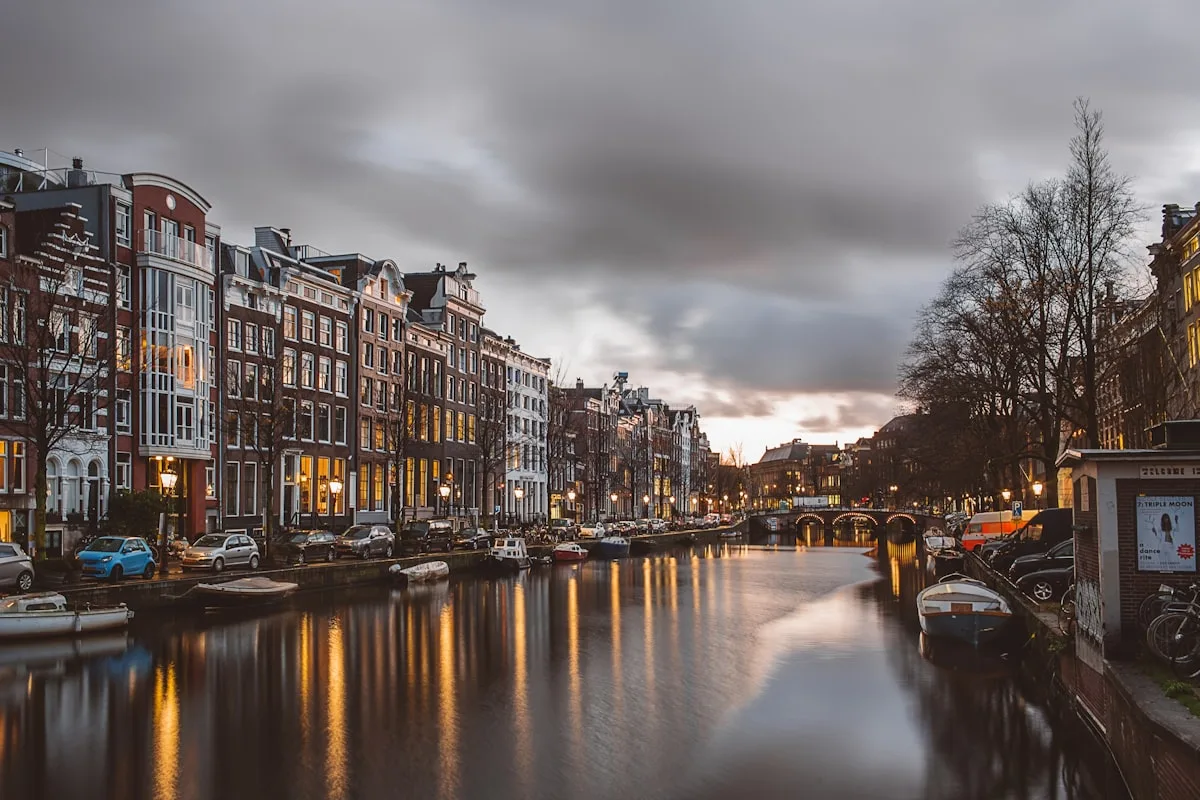
From Friday, May 1, 2026, Amsterdam has stopped selling its public-advertising real estate to companies promoting meat, petrol and diesel cars, commercial flights, cruises and gas heating contracts, making the Dutch capital the first capital city in the world to enforce such a ban. The bylaw, passed by the Gemeenteraad (city council) in a 27-17 vote in January 2026, treats high-carbon products and services the way tobacco was treated in the late 20th century: still legal to buy, but no longer allowed to be normalised in public space.
The ban applies to all advertising on city-controlled infrastructure—approximately 1,350 bus-shelter panels, 225 screens across metro stations, and 470 freestanding sidewalk panels, many of them backlit. It does not reach private property, digital advertising or social-media feeds. The case for the policy rests on Amsterdam's own legal commitment to net-zero by 2050 and to halve local meat consumption over the same horizon, and on a 2020 council promise that this bylaw is now finally implementing. The case against rests on commercial-freedom and free-speech arguments that a Dutch court has already rejected in a parallel case in The Hague.
What exactly is now banned
The bylaw covers five high-carbon advertising categories that Amsterdam's council groups together as inconsistent with city climate policy. First, personal road transport powered by fossil fuels: petrol and diesel passenger cars, including SUVs. Second, commercial aviation: airline tickets and the package-holiday airlines that rely on outbound flights from Schiphol Airport. Third, cruises: large-ship holidays operating out of Amsterdam's passenger terminal and elsewhere. Fourth, gas heating contracts for residential and commercial buildings, in line with the city's push to phase out natural-gas connections. Fifth, meat products, with particular focus on the fast-food burger category that dominates the few meat ads still bought on Amsterdam billboards.
Meat was, in advertising terms, a small slice: the category represented an estimated 0.1% of Amsterdam's outdoor ad spend, against roughly 4% for fossil-related products, with the remaining majority occupied by clothing brands, movie posters and mobile phones, according to BBC News. The city expects to lose up to 7.5% of advertising-contract revenue from the combined restrictions, a manageable hit that the council has accepted as the price of policy coherence. Shops are permitted, under a council policy document, to advertise their own products in a "limited" way outside their own premises, preserving small-trader signage while removing high-volume billboard campaigns.
How a 27-17 vote got here
The bylaw's parliamentary path runs through a coalition that has reshaped Amsterdam's environmental politics since 2018. GroenLinks (GreenLeft), the Party for the Animals (PvdD), and Labour-and-progressive allies built the majority that delivered the 27 to 17 result in January 2026, against opposition from Liberal and Christian-democratic factions. Anke Bakker, Amsterdam group leader of the Party for the Animals, "instigated the new restrictions," in the BBC's words, and frames the ban not as paternalism but as a freedom-protection device: "we are trying to get the big companies not to tell us all the time what we need to eat and buy," she said.
Anneke Veenhoff of GreenLeft made the consistency argument: "if you want to be leading in climate policies and you rent out your walls to exactly the opposite, then what are you doing? Most people don't understand why the municipality should make money out of renting our public space with something that we are actively having policies against." Council records show that the policy was actively lobbied against in the weeks before the vote—JCDecaux, the world's largest outdoor advertising operator, warned Amsterdam politicians about "far-reaching financial and legal consequences," according to climate-investigative outlet DeSmog—but the lobbying did not flip the vote.
Why ban meat ads, not just car and flight ads
Globally, livestock is estimated to account for between 14 and 18 percent of total human-made greenhouse gas emissions, and nearly 60 percent of the food sector's emissions, according to figures cited by Earth.Org from research at Stanford and elsewhere. Beef and dairy are by far the most carbon-intensive food categories on a per-calorie and per-kilogram basis, driven by methane from ruminants and land-use change for grazing and feed crops. Cutting per-capita meat consumption is therefore a structural prerequisite for any city or country claiming a credible net-zero by 2050 pathway.
Amsterdam's bylaw makes the political move of grouping meat with flights, cruises and combustion cars. "Grouping meat with flights, cruises and petrol and diesel cars reframes it from a purely private dietary choice to a climate issue," BBC business reporter Anna Holligan wrote from Amsterdam. Hannah Prins, lawyer with Advocates for the Future and a partner of the campaign Fossil-Free Advertising / Reclame Fossielvrij, has been explicit that the campaign is trying to engineer a "tobacco moment" for high-carbon food—comparing the social acceptability of meat ads today to images of footballer Johan Cruyff in cigarette ads in mid-20th century Dutch media.
The tobacco-style policy logic
The bylaw rests on a well-evidenced public-health analogue. A global review of tobacco-advertising bans, published in the journal Tobacco Control in early 2025, found such policies were associated with 20 percent lower odds of current smoking and a 37 percent reduced risk of people taking up smoking for the first time. Tobacco-control researchers and the WHO have long argued that comprehensive ad bans—covering point-of-sale, billboards, sponsorship and digital channels—are the only versions that reliably depress uptake, while partial bans tend to be substituted around by industry.
Climate communicators and behavioural-policy academics argue the same logic applies to fossil-fuel and meat advertising, while cautioning that effects accumulate slowly. "Would this advertisement ban lead to behavioural changes overnight? Well, the answer is no," Jan Willem Bolderdijk, professor of sustainability and marketing at the University of Amsterdam, told DW. "It's taken decades for these types of consumption norms to emerge." Reint Jan Renes, a behavioural psychologist at Amsterdam's University of Applied Sciences, frames the underlying problem in policy-coherence terms: "the moment you really take your own climate policy seriously, then you should at least restrict the availability of all those promotional materials, where the only thing they try to do is to promote and normalize these high-carbon lifestyles."
What the climate numbers look like
A 2024 study by Greenpeace Netherlands and the New Weather Institute estimated that car and airline advertising in the European Union in 2019 alone could be responsible for up to 122 million tonnes of greenhouse-gas emissions—more than the annual emissions of Belgium. That number is a model output, not a direct measurement, but it captures the basic logic that advertising shifts purchase mix toward higher-carbon products, especially in categories like larger SUVs, long-haul flights and multi-night cruises where the marginal carbon footprint of an upsell is large.
On the demand side, the Intergovernmental Panel on Climate Change (IPCC) has estimated that demand-side changes—shifts in consumer habits and lifestyle, including diet and mobility choices—could deliver a 40 to 70 percent reduction in global emissions by 2050, provided the right policies, infrastructure and technology are in place. Amsterdam's ad ban is, in IPCC terminology, one of many "avoid-shift-improve" levers: it does not by itself decarbonise food or transport, but it removes part of the marketing flywheel that pushes consumption toward the most polluting versions of both.
What the ban does not do
Even supportive analysts concede that the policy has real gaps. Digital advertising—Meta, Google, TikTok, YouTube, Spotify, search-engine bidding—is not covered. "Stand at a tram stop in Amsterdam and you might no longer see a juicy burger or a 19 euro flight to Berlin on the shelter," BBC's Holligan noted. "Yet the same eye-catching offers can still pop up in your social media algorithm. And, let's face it, many of us would be looking down at our screens until the tram trundles along." Most outdoor ad budgets have, in any case, been migrating to digital channels for over a decade.
The ban also does not touch private property—shop windows, restaurant menu boards, supermarket flyers and in-store displays are unaffected, beyond the "limited" outside-premises advertising allowance written into the council document. It does not regulate sponsorships of museums, sports clubs or cultural festivals, an area where oil-and-gas majors have built decades of brand presence in the Netherlands. And it does not, by its own design, restrict consumer choice: residents and tourists can still buy any of the products in question on every street, with or without a billboard.
The legal precedent: The Hague's win in court
The legal underpinning that gives Amsterdam confidence is the April 2025 Dutch court ruling that upheld the City of The Hague's 2024 ban on advertising for petrol and diesel cars, cruises and air travel. The Dutch Association of Travel Agents and Tour Operators (ANVR) and the TUI tour-operator group had challenged the bylaw, arguing that it violated commercial free-speech, conflicted with EU trade law, and exceeded the city's authority. A Dutch court rejected all three lines of attack, ruling that commercial advertising falls outside constitutional free-speech protections, that climate and public-health goals justify restrictions on trade, and that the commercial interests of advertisers do not outweigh the general health interests of citizens.
Femke Sleegers of Reclame Fossielvrij called the ruling a "breakthrough" at the time. "Just as anti-smoking policies are ineffective when tobacco ads are everywhere, we can't have effective climate policy while fossil-fuel products are promoted on every street corner." Amsterdam city lawyers spent the rest of 2025 stress-testing their own draft bylaw against the same legal framework, which is why the January 2026 vote came with a relatively narrow opposition and no parallel court challenge has so far blocked the May 1 commencement.
Critics: nanny state, lost revenue, free speech
The Dutch Meat Association, representing the country's meat industry, called the ban "an undesirable way to influence consumer behaviour," adding that meat "delivers essential nutrients and should remain visible and accessible to consumers." The ANVR travel-industry group said banning advertising for holidays that include air travel is a disproportionate curb on companies' commercial freedom. Liberal and conservative Dutch lawmakers have characterised the bylaw as nanny-state policy that restricts freedoms, while JCDecaux and other outdoor-ad operators have flagged revenue losses across the estimated 7.5% contract drop.
Then there is the symbolic-politics critique: that the policy is, in practical terms, a small intervention that lets the city signal climate seriousness without doing the harder work of cutting emissions from heating, mobility and food procurement. Even supportive academics like Bolderdijk agree the ban is "just one of the many measures that are necessary," part of "a package of interventions that together can change these carbon-intensive social norms." Whether voters and other capitals read the result as serious policy or as virtue-signalling will shape the political appetite for follow-on measures.
Where this fits in a wider European movement
Amsterdam is the first capital, but not the first city, to take this step. Haarlem, 18 kilometres west of Amsterdam, announced a broad ban on meat advertising in public spaces in 2022, with the bylaw and a fossil-fuel ban taking effect in 2024. The Hague, the seat of the Dutch government, followed in 2024. Utrecht and Nijmegen have extended the framework to also explicitly restrict meat (and in Nijmegen's case dairy) advertising on municipal billboards. Stockholm will introduce its own ban this summer. Edinburgh, Sheffield, Sydney and Florence already have measures in force or in adoption.
France in 2022 became the first country to restrict fossil-fuel advertising nationwide. Spain could become the first country to impose a fully nationwide ban covering fossil fuels, fossil-fuelled vehicles and short-haul flights where rail alternatives exist—a draft bill was approved by the Spanish government in 2025. The World Without Fossil Ads registry counts more than 50 cities worldwide that have either banned, restricted or formally proposed such measures. UN Secretary-General António Guterres has explicitly called on governments to ban fossil-fuel advertising the way they restricted tobacco, accusing "Mad Men" advertising and PR agencies of "fuelling the madness" of climate inaction.
What happens next
Three concrete signals will tell readers how durable Amsterdam's move is and how far it travels. First, whether any legal challenge is filed against the Amsterdam bylaw before the EU general courts or the Dutch Council of State, and whether the April 2025 The Hague precedent survives scrutiny at a higher European level. Second, whether Stockholm's summer rollout, Spain's national bill, and Italian and Scottish equivalents extend the legal blueprint that links meat with fossil fuels rather than treating them separately.
Third, whether researchers can begin to measure behavioural effects. Joreintje Mackenbach, an epidemiologist at Amsterdam University Medical Center, has described the policy as "a fantastic natural experiment." Comparable London Underground research on the city's 2019 ban on junk-food advertising found measurable reductions in household purchases of high-calorie foods, suggesting that even partial outdoor-ad restrictions can shift behaviour at the margin. Whether Amsterdam's data points the same way over the next two to three years will determine if "the meat moment" becomes a real policy template, or stays a Dutch experiment with a global press footprint.
Bottom line
Amsterdam is not banning meat or flights or petrol cars. It is banning paid public-space promotion of those products inside city-controlled infrastructure, on the explicit theory—well established in tobacco-control science—that what cities normalise in their streetscape shapes what citizens consider an aspirational lifestyle. The bylaw, narrowly drawn against city-owned outdoor inventory, sits within a 2050 net-zero plan, a 50% meat-cut target, and a 2020 council commitment that the January 27-17 vote now operationalises. It will not, on its own, drop the city's emissions curve. It will, supporters argue, make the next harder decisions—on heating gas connections, on Schiphol capacity, on dietary transitions in public canteens—politically thinkable, where today they often are not.