Why Bayern refuses to be ‘just another Bundesliga club’
Bayern Munich is the gravitational centre of modern German club football: trophies concentrate here, international broadcasters learn German football through red shirts, and rivals define themselves partly in opposition to Bavaria’s economic scale. Supporters speak of Mia san mia—we are who we are—as both pride and demand; critics call it predictability. Either way, the club rarely argues from the margins.
Origins: MTV schism, 1900, and Munich’s football boom
Bayern’s genealogy begins with broader gymnastics culture: MTV München (1879) centred Turnen—German gymnastics—and delayed fully embracing organised association football on terms ambitious players wanted. By the late 1890s, southern Germany’s football association (SFV) structured leagues; MTV hesitated over integrating footballers on association rules—friction grew between gymnastic tradition and players seeking regular competition.
On 27 February 1900, a group usually counted at eleven football-focused members broke away—club lore places the meeting at the Gasthof zum Gisela near central Munich—and chartered Fußball-Club Bayern München. Franz John, photographer and organiser, became first president (1900–1903): he filed paperwork, aligned Bayern with the SFV, and stabilised early finances while squads borrowed grounds around Schwabing and Maxvorstadt.
Kit colours shifted early from sky-blue-and-white toward the red-led palette fans treat as civic shorthand for Bavaria. Friendly and regional fixtures knitted networks across southern Germany—Nürnberg rivalries appear almost immediately in newspaper columns—before World War I interrupted leagues; veterans’ stories later fed interwar attendance rebounds.
Weimar-era Munich mixed politics and terraces; World War II brought stadium damage and player losses. Post-1945 rebuilding inside Oberliga Süd grids positioned Bayern for nationwide exposure once 1963’s Bundesliga turned weekly matches into a federal television ritual—Bavaria’s industrial base and Oktoberfest tourism soon sat behind sponsor decks as predictably as rail freight once fed factories.
Allianz Arena: colour-changing skin and matchday engineering
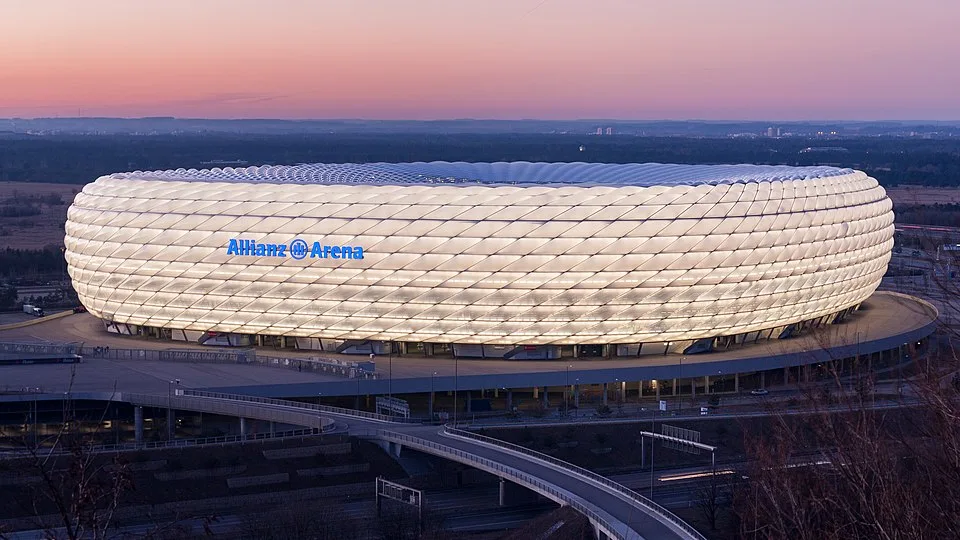
Since 2005, home matches have lived inside the Allianz Arena—famous for ETFE panels that shift colour for club identity, national games, and concerts. Capacity sits in the low-to-mid seventy-thousands depending on competition rules—large enough to anchor Champions League nights and summer tours alike.
Stadium financing is long-duration debt dressed as optimism: naming rights, hospitality, and non-football events smooth cash flow when squad cycles wobble. Fans argue whether atmosphere beats older bowls; accountants argue only about yield per seat.
European peaks and domestic inevitability
Bayern’s trophy room spans European Cup / Champions League eras—from 1970s three-peats in European football’s defining decade for German clubs, through 2001 in Milan, 2013 at Wembley, 2020 in Lisbon’s one-leg summer bubble—to recurring quarter-final minimum expectations every spring.
The Bundesliga narrative is often framed as Bayern plus chasing pack: sometimes competitive (2018–2019 drama), sometimes procession-like. That framing irritates Munich supporters who remember injuries and managerial sack races; it irritates rivals who want parity rules enforced harder.
Derbies, rivals, and the cultural soundtrack
Der Klassiker against Borussia Dortmund is Germany’s premium TV product—often decisive for titles, always decisive for talking-head economics. Against 1860 Munich, city geography once mattered more; hierarchy now tilts heavily red. European draws supply additional villains—Spanish giants, English spenders—who treat Bayern as the Bundesliga’s balance-sheet benchmark.
Timeline — milestones still cited in searches
Use this as orientation; verify trophy totals against official season rolls.
- 1900 — Club founded after Munich gymnastics split; football section formalised.
- 1932 — National championship in pre-Bundesliga football—continuity through unstable political decades.
- 1965 — Promotion to Bundesliga; foundation of modern top-flight era.
- 1974–1976 — Three consecutive European Cups—German football’s golden European cycle alongside broader national-team success.
- 2005 — Allianz Arena opens; stadium identity matches global branding push.
- 2013 — Treble season (Jupp Heynckes)—domestic double plus Champions League at Wembley.
- 2020 — Treble under Hansi Flick—Lisbon bubble Champions League among pandemic constraints.
- 2020s — Squad transitions (Kane era chapters), coaching changes, and ongoing debate over Bundesliga competitive balance.
Snapshot — numbers readers actually compare
Totals below come from different snapshots: club revenue is tied to 2024/25 reporting cycles in euros; follower totals aggregate official club accounts across major platforms using CIES methodology as of June 2024. They are not interchangeable—one is accounting, the other is audience reach.
| Metric | Value |
|---|---|
| Total revenue (€m, 2024/25 season, widely cited annual football finance surveys) | 861 |
| Combined social followers (millions, official accounts on Facebook, X, Instagram, TikTok—CIES June 2024) | 137 |
Achievements and standout stats
Honours lists lengthen every successful spring—check league and UEFA sites before treating any total as final. Bayern’s statistical identity combines extraordinary domestic championship volume with repeated European finals appearances across decades.
Commercially, the club sits beside Europe’s largest revenue pools—sponsor portfolios, licensing, and stadium events scale with brand recognition across Asia and North America.
- Bundesliga dominance: record championship totals at the summit of German league football—often the first line in any argument about competitive imbalance.
- European trophies: multiple Champions League / European Cup wins spanning 1970s, 2000s, 2010s, and 2020s—including famous treble seasons fans shorthand by coach name.
- DFB-Pokal rhythm: deep cup runs stack seasons where league margins look thin—domestic doubles remain an expectation, not a surprise.
- Allianz Arena footprint: among Germany’s largest club stadiums by capacity—light-show branding visible from kilometres away on match nights.
- Commercial and audience scale: major football finance surveys and social-audience studies place Bayern near the top tier globally on revenue and combined platform followers—the snapshot table above reflects that weight class.
Bottom line
Bayern’s arc is Bavarian scale plus European ambition plus Bundesliga politics. Hold sporting cycles, revenue tables, and fan culture as linked but separate stories—or analysis mistakes identity for inevitability. Next season’s squad refresh will rewrite narratives again—but Mia san mia will still be the reply.