Why City searches spike even when the derby isn’t on the calendar
Manchester City travels through two lenses at once: stadium geography east of the city centre, and economics—broadcast pools, sponsorship headlines, and periodic governance scrutiny that keeps the club’s name in news indexes alongside scorelines. Premier League exports mean casual viewers often know Sky blue kits before they could trace the River Irwell.
Origins — St. Mark’s, Ardwick, and the 1894 name that stuck
Victorian factory chapels and factory whistles framed early organisation: St. Mark’s (West Gorton) supplied the charitable-football habit that hardened into Ardwick AFC (1887) and, after reorganisation and identity consolidation, Manchester City (1894). The club joined the Football League as it thickened into national ritual—Manchester’s industrial crowds supplied terraces long before corporate hospitality tiers.
Gate money first anchored Hyde Road—tight corners, wooden stands, mud that judged dribblers honestly—as Ardwick earned Second Division admission (1892) before the Manchester City rename (1894) reflected civic ambition on letterheads supporters still pronounce with Maine Road vowels. League ballots and re-election theatre shaped Edwardian summers as brutally as transfers do now; survival meant convincing peers your gate could sustain rail fares for visitors.
1904 delivered the FA Cup—City became the first Manchester club to lift it—proof that Lancashire workshop humour could pair with silver even before Old Trafford’s empire narratives hardened. Interwar cycles mixed glamour trips to Wembley with relegation humour that terrace comedians recycled into folk memory; World War I registers interrupted careers and stadium timber alike.
Hyde Road’s limits—sightlines, crush risk, and revenue ceilings—made Maine Road (1923) inevitable civic engineering: Manchester needed a municipal-scale bowl when rivals grew gates faster than sympathy. Early City chapters oscillated between promotion ambition and mid-table patience; Maine Road (1923–2003) became the acoustic centre of supporter memory—foggy photography, Kippax terrace folklore, and later all-seater transitions as safety culture rewrote standing-room assumptions UK-wide.
Maine Road, tumult, and the stadium fork that became the Etihad
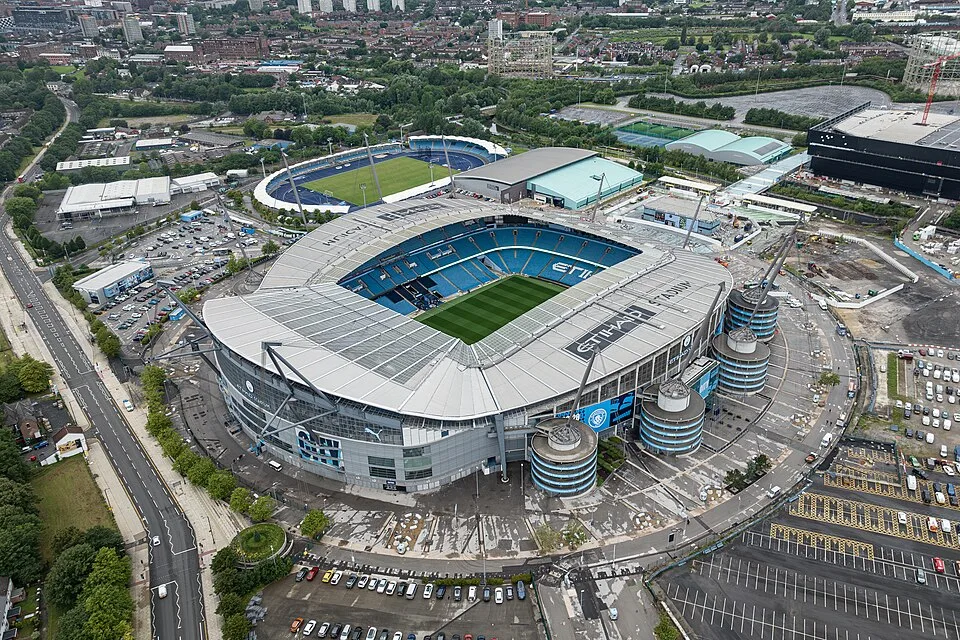
Maine Road hosted domestic finals for others during wartime breaks; for City it was home across relegation humour and occasional glamour—FA Cup romance mixed with lower-division years that shaped generational supporter humour. The move to the City of Manchester Stadium followed 2002 Commonwealth Games reuse: athletics track removal, pitch dimensions, and naming-rights cycles turned a municipal mega-project into a football-first arena now widely called the Etihad after sponsorship.
Capacity sits above 50,000 in modern football configurations—concourse density and premium seating economics mirror how Premier League inventory pairs matchday yield with global streaming audiences.
Investment cycles, coaching clarity, and silverware acceleration
Takeover headlines (2008) reframed recruitment budgets and academy infrastructure; managerial succession eventually stabilised around Pep Guardiola (2016–), whose possession architecture and positional rotations became the tactical shorthand for an entire Premier League decade. Domestic cups and league titles stacked alongside European progression—culminating in a 2023 UEFA Champions League win that completed a treble narrative English television repeated on loop.
Supporters’ songs and social clips now duel with regulatory filings in search results—football success and institutional process occupy adjacent browser tabs.
The derby and the Northwest trophy corridor
Against Manchester United, civic sibling rivalry mixes housing geography with trophy arithmetic—each derby rewrite feeds documentary crews and podcast economies. Against Liverpool, recent title races turned pressing transitions into appointment television; against London clubs, broadcast scheduling frequently pairs City with Chelsea or Arsenal as narrative foils.
Timeline — milestones still cited in searches
Confirm trophy totals against official club and UEFA tables—competition names change with eras.
- 1880 — Church-linked roots in West Gorton—the charitable-football pathway into organised competition.
- 1887 — Ardwick AFC—nameplate before the modern club identity.
- 1894 — Manchester City adopted—legal personality stabilises the institution investors later scale.
- 1904 — FA Cup win—early national trophy proof before league dominance narratives.
- 1923 — Maine Road opens—generations of matchday memory anchor here.
- 1937 — League champions—interwar ceiling before post-war oscillation.
- 1998 — Division Two play-off final—late-90s survival lore still clips well.
- 2002–2003 — Commonwealth Games venue and move from Maine Road—stadium economics pivot.
- 2008 — Change of ownership—global headlines and squad rebuild acceleration.
- 2016 — Pep Guardiola appointed—tactical brand becomes league-wide reference.
- 2022–2023 — Premier League, FA Cup, UEFA Champions League in one season—treble shorthand enters highlight permanence.
- 2020s — Ongoing regulatory and governance headlines run parallel to matchday excellence—separate accounting from goals scored.
Snapshot — numbers readers actually compare
Totals below come from different snapshots: club revenue is tied to 2024/25 reporting cycles in euros; follower totals aggregate official club accounts across major platforms using CIES methodology as of June 2024. They are not interchangeable—one is accounting, the other is audience reach.
| Metric | Value |
|---|---|
| Total revenue (€m, 2024/25 season, widely cited annual football finance surveys) | 829 |
| Combined social followers (millions, official accounts on Facebook, X, Instagram, TikTok—CIES June 2024) | 158 |
Achievements and standout stats
Domestic naming conventions shifted across divisions—verify league-era totals before citing championship counts. City’s statistical reputation rests on concentrated 2010s–2020s domestic dominance plus the 2023 European title that completed a long continental quest narrative.
Commercially, Etihad campus branding—training ground, academy buildings, stadium naming—pairs with overseas tours and documentary-friendly squads; matchday economics intertwine with broadcast pools that fluctuate with UEFA coefficient arithmetic.
- Premier League: multiple titles across the 2010s–2020s—often cited alongside points records and goal-difference margins from tightly contested seasons.
- Domestic cups: repeated FA Cup and EFL Cup wins—calendar congestion trophies that nonetheless demand squad depth.
- UEFA Champions League: 2023 Istanbul final added the missing continental headline to a decade of domestic accumulation.
- Domestic treble seasons: 2018–2019 men’s treble of league plus both major domestic cups; 2022–2023 treble including European crown—both anchor highlight packages.
- Etihad Campus: integrated training and youth infrastructure advertised as long-horizon player development—audited separately from first-team transfer windows.
- Commercial and audience scale: major football finance surveys and social-audience studies place City among the largest clubs on revenue and combined platform followers—the snapshot table reflects that tier.
Bottom line
City’s arc is Victorian parish football plus Maine Road mythology plus municipal stadium conversion plus modern trophy acceleration—arguments about sustainability rules and league governance run beside the football, not instead of it. Next season’s line-up sheet will change again; the search box will still pair Etihad photographs with balance-sheet commentary.