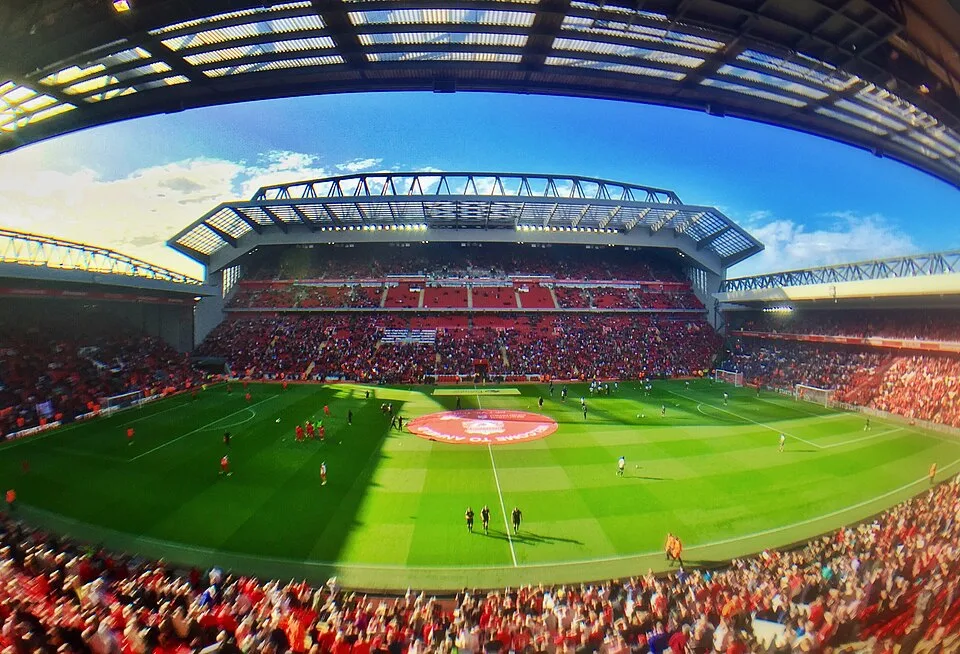
Why Liverpool travels farther than most clubs’ geography
Liverpool FC sells simultaneity: dock-city humour, You’ll Never Walk Alone sung by people who never crossed the Mersey, and a European trophy lineage that invites debate every spring. Premier League television exports emotion alongside tactics—so casual audiences often “know” Anfield before they could pick Liverpool on a blank map.
Origins — 1892, Houlding, and the ground Everton left behind
Association football on Anfield predates Liverpool FC: Everton played there from 1884 until a rent-and-ownership dispute with landlord John Houlding pushed the blue half of the city toward Goodison Park. Rather than idle the enclosure, Houlding and allies incorporated Liverpool Football Club—registered 15 March 1892—borrowing Scottish recruitment (McKenna, McQueen) to assemble a side competitive enough for league admission.
That split framed Merseyside football as sibling rivalry across Stanley Park—families divided by fixture lists for generations. Early Liverpool leaned on northern England’s industrial crowds—dock shifts, Irish migration waves, chapel networks—melting into terraces long before satellite dishes.
Promotion cycles and Football League consolidation (1893–1894) positioned Liverpool inside structured national competition; interwar titles fed terrace swagger before television existed. Post-war rebuilding mirrored Liverpool port economics—when freight slowed, matchday ritual steadied civic rhythm.
Edwardian Liverpool lifted league trophies while harbour cargoes shifted global grain routes—Tom Watson’s early managerial cycles threaded pragmatism through ships’ clocks. Between wars, Anfield crowds debated wingers and wing halves while Depression unemployment stalked docks; football stayed appointment viewing because civic unemployment offices did not.
World War II bombing scarred the city and disrupted squads—players served, gates dipped, timber stands burned—yet Anfield rebuilt alongside terrace humour that weaponised gallows wit. Post-war Division Two relegation (1954) humbled a club that had known championships; fifteen seasons outside the top flight seeded the cultural hunger Bill Shankly would exploit—proving origins are not only triumph arcs but shame seasons supporters tattoo into identity.
Shankly, the boot room, and the European escalator
Bill Shankly’s arrival (1959) fused socialist-flavoured work ethic with stadium renovation ambition—Anfield became theatre rather than merely shed. The boot room lineage (Paisley, Fagan, Dalglish) institutionalised continuity: coaches promoted from inside the building understood which myths to preserve when tactics evolved.
European nights escalated from novelty to ritual—1970s and 1980s finals turned Liverpool into England’s primary continental narrator before the Premier League era rebranded weekly football as global inventory.
Tragedy, justice campaigns, and memory as infrastructure
Heysel and Hillsborough sit inside Liverpool’s public memory architecture—legal fights lasted decades; supporter organising reshaped stadium safety assumptions UK-wide. Songs and memorials are not decorative—they police how outsiders speak about the club without sounding cruel.
Rivalries that schedule television years in advance
Against Manchester United, northwest economics and trophy envy collide with motorway sociology. Against Everton, geography compresses into derby oxygen—form tables rarely predict emotion. European draws supply rotating villains—Spanish possession sides, Italian defensive blocks—each era teaches new insult choreography.
Timeline — milestones still cited in searches
Confirm trophy totals against official club and UEFA tables—competition names change with eras.
- 1892 — Club founded after Everton exit from Anfield; John Houlding anchors landlord lore.
- 1901 — First league championship—early proof Liverpool could outgrow provincial-label football.
- 1959 — Bill Shankly appointed—cultural reset still cited in every managerial comparison.
- 1977–1984 — Multiple European Cup wins—Paisley-era dynasty shorthand.
- 1989 — Hillsborough disaster—97 supporters ultimately recognised among the unlawfully killed; justice campaigns reshape English football governance narratives.
- 2005 — Istanbul Champions League final—comeback mythology enters permanent clip rotation.
- 2019–2020 — Jürgen Klopp cycle delivers Champions League and Premier League titles—modern stadium expansions pair with global streaming audiences.
- 2020s — Ownership debates, squad turnover, and renewed European weekends—revenue tables track broadcast pools as tightly as pressing maps.
Snapshot — numbers readers actually compare
Totals below come from different snapshots: club revenue is tied to 2024/25 reporting cycles in euros; follower totals aggregate official club accounts across major platforms using CIES methodology as of June 2024. They are not interchangeable—one is accounting, the other is audience reach.
| Metric | Value |
|---|---|
| Total revenue (€m, 2024/25 season, widely cited annual football finance surveys) | 836 |
| Combined social followers (millions, official accounts on Facebook, X, Instagram, TikTok—CIES June 2024) | 144 |
Achievements and standout stats
Domestic naming conventions shifted across divisions—always verify league-era totals before citing championship counts. Liverpool’s statistical reputation rests on repeated European finals appearances plus sustained domestic trophy volume across decades.
Commercially, expanded Anfield seating (north of 60,000 in recent configurations) pairs hospitality upgrades with overseas supporter tourism—matchday economics intertwine with documentary crews and documentary-friendly managers.
- European Cup / Champions League: among England’s most decorated clubs at continental level—several distinct golden eras (1970s–1980s, 2000s, 2010s–2020s) anchor highlight reels.
- Domestic leagues: multiple First Division / Premier League titles—often bundled with FA Cup and League Cup chapters under single managerial regimes.
- Anfield expansion: phased stand rebuilds aim to protect acoustic mythology while maximising premium seating yield.
- Global anthem economy: You’ll Never Walk Alone operates as simultaneous grief vessel and tourist selfie soundtrack—brand recognition few peers match.
- Commercial and audience scale: major football finance surveys and social-audience studies place Liverpool among the largest clubs on revenue and combined platform followers—the snapshot table reflects that tier.
Bottom line
Liverpool’s arc is dock-city institution plus European theatre plus civic grief translated into stadium ethics. Hold sporting cycles, revenue reporting, and supporter politics as separate lenses—or debates flatten into nostalgia contests. Next summer’s midfield rebuild will rewrite narratives again—but the Kop expects noise regardless.