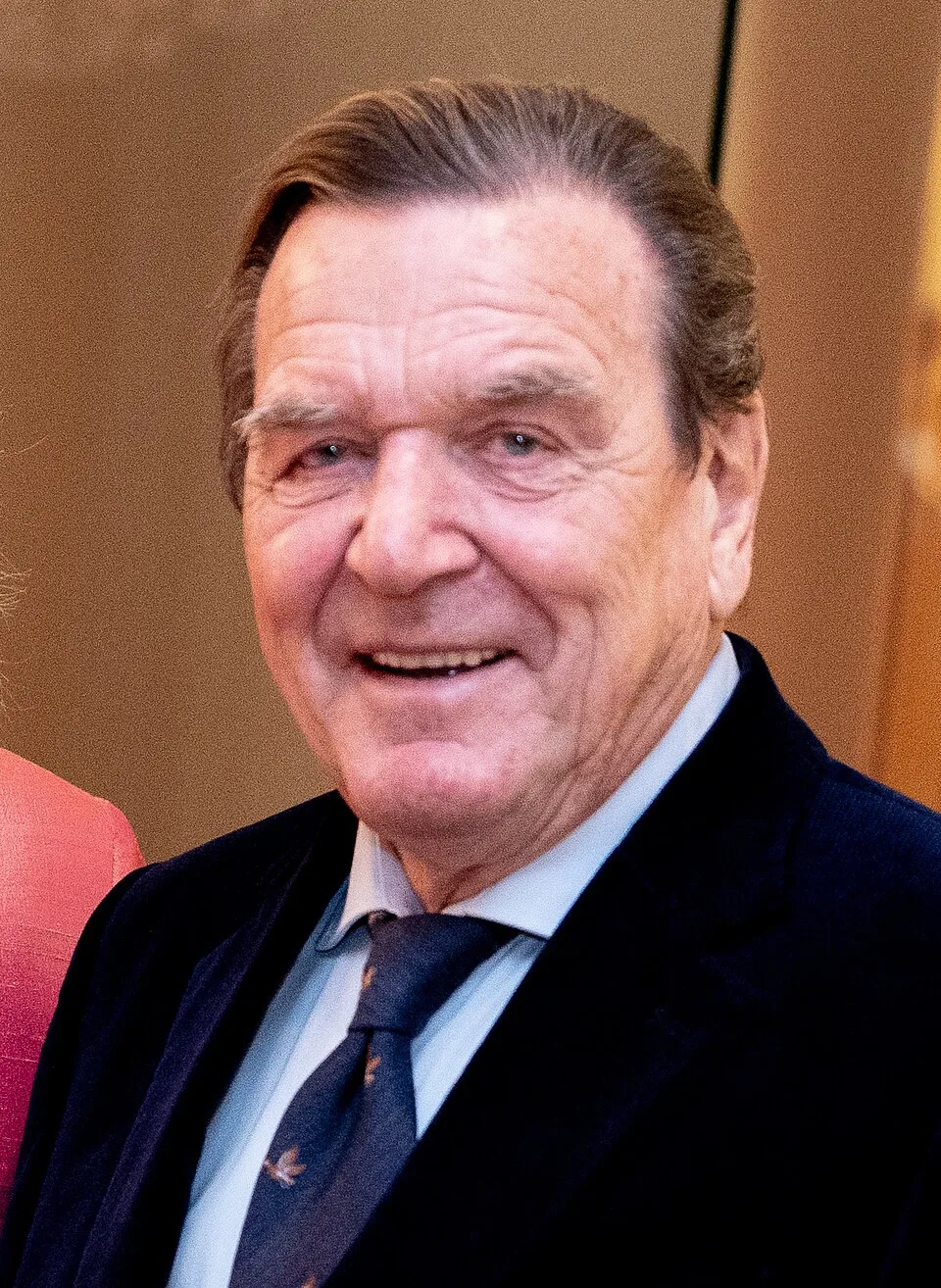
In May 2026, after Russia’s Victory Day commemorations, President Vladimir Putin publicly suggested Gerhard Schroeder—Social Democratic chancellor of Germany from 1998 to 2005—as someone he would “personally” prefer to help coordinate peace diplomacy toward Europe over Ukraine, according to widespread press accounts. The pitch landed not as a curriculum vitae but as a provocation: within days, senior European diplomats were treating it as incompatible with the EU’s demand for negotiators who do not double as veterans of Russian state energy boards.
Schroeder is eighty-two. His post-office résumé is dominated by Nord Stream AG, Nord Stream 2, Rosneft, and a shelved Gazprom supervisory role—positions he largely gave up under pressure after the full-scale invasion of Ukraine began in February 2022. That record is why Moscow can cast him as a familiar interlocutor and why Kyiv and most EU capitals read him as structurally aligned with the Kremlin’s commercial interests, whatever his personal feelings about war and peace.
Why Brussels treated the name as disqualifying
EU foreign ministers, convening in Brussels on 11 May 2026, rejected the idea in public shorthand: a mediator cannot plausibly be neutral if he has been, in effect, on retainer to the same state-owned firms that finance the Russian budget. EU foreign policy chief Kaja Kallas told reporters that Schroeder had been “a high-level lobbyist for Russian state-owned companies” and that it was therefore obvious why Putin wanted him—because he could “be sitting on both sides of the table” (quoted speech reported from the Brussels stakeout).
German voices joined the chorus: coverage of Berlin’s reaction cited arguments that Schroeder could not credibly serve as an “honest broker” alongside Putin because the friendship alone forecloses impartiality in the eyes of European capitals (reported). Other officials, quoted anonymously through agencies, framed Putin’s gesture as intended to sow friction inside the Western coalition rather than to table a negotiator Europe could accept (reported). The unanimity matters: mediation only works when both camps accept the chair; here, rejection arrived before talking points could be printed.
Pipelines, board seats, and Germany’s gas bet
Schroeder left the chancellery in 2005 after losing to Angela Merkel, then almost immediately chaired Nord Stream AG’s shareholder committee—timing his critics still call the blueprint for Germany’s long dependence on Russian molecules under the Baltic. He later promoted Nord Stream 2 and joined the board of Rosneft; a Gazprom supervisory appointment slated for 2022 never materialized after February’s invasion drove him off corporate rosters amid domestic outrage.
He never issued the full-throated break with Putin that many German politicians demanded. In a 2024 DPA interview he insisted their long working relationship could still lubricate diplomacy—“We have worked together sensibly for many years… I don’t see another solution”—a line allies read as denial and Moscow reads as open channel. Whether or not one agrees, the factual spine is concrete: a decade and a half of paid energy ties is hard to square with the image of a referee who owes nobody in Moscow a favour.
Friendship, backlash, and domestic price tags
The Schroeder–Putin bond antedates the pipelines: Putin’s German, honed in Dresden as a KGB officer, made private dinners and public appearances easy theatre. Schroeder’s 2004 remark calling Putin a “flawless democrat” aged into a millstone as Russian civic space tightened. His seventieth birthday in St. Petersburg with Putin in 2014 landed weeks after Russia seized Crimea; Schroeder’s attempt to analogize that move to NATO’s Kosovo campaign only widened the crack with his own party.
After 2022 the Social Democratic hierarchy moved to expel him; he survived the process but lost practical standing—Germany’s budget committee withdrew taxpayer-funded office support for a former chancellor argued to have shirked post-office national duty. The punishment is as political as legal: it signals that Berlin institutions, whatever their coalition fights, will not pretend Schroeder is an ordinary elder statesman when Ukraine policy is debated.
Mediation needs buy-in; this episode offered none
Putin also hinted at hypothetical direct contact with Ukrainian president Volodymyr Zelenskyy if the “core terms” of peace were pre-cooked—a sequencing demand Kyiv has long treated as surrender-before-talks (reported framing). Meanwhile Kremlin spokesperson Dmitry Peskov told journalists true peace remained a “very long way” off (reported), a reminder that Moscow’s public signalling can oscillate between outreach and attrition in the same news cycle.
Absent European consent, Schroeder cannot be the EU-facing mediator Putin floated; the episode instead clarifies battle lines—who counts as independent, which energy histories disqualify a chair, and how little patience remains in Brussels for personalities recycled from the Nord Stream era. The substantive war file—territory, security guarantees, reconstruction—remains where it was before the name-drop: stuck, with continued fighting and sanctions in the background, on whether either side believes the other can offer a deal worth the political cost of signing.