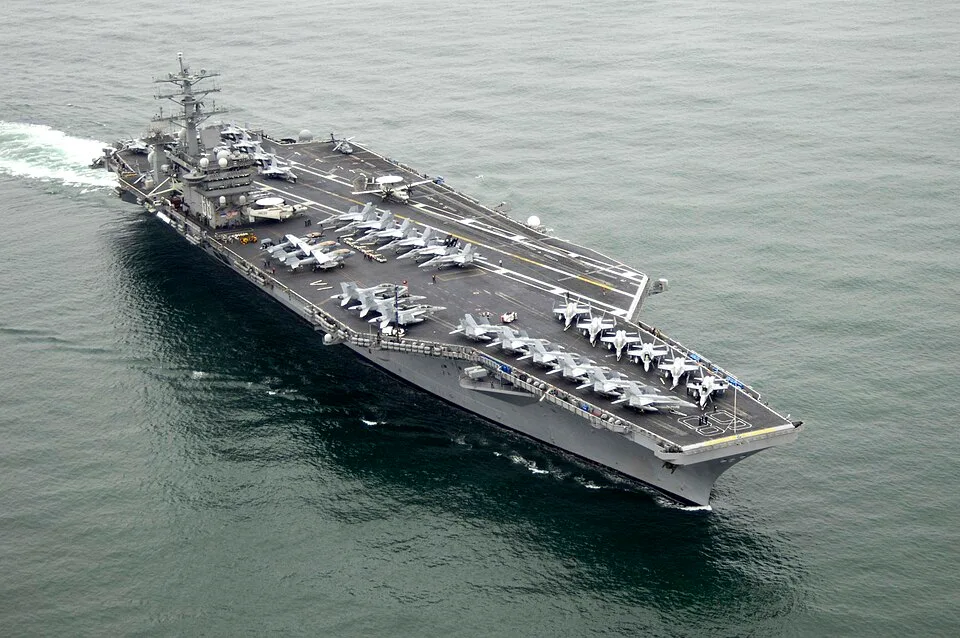
What this is—and what it is not
Readers searching for a live map of every battleship—a category the U.S. Navy retired generations ago—will not find it here. What follows is a journalism-grade snapshot: open-source reporting, allied press releases, and expert fleet tracking that describes aircraft carriers, destroyers, frigates, amphibious groups, and mine-warfare assets relevant to the Strait of Hormuz and adjacent seas as of early May 2026.
No newsroom can see all classified sailing orders. Automatic Identification System data can be spoofed, switched off, or misread. Treat this article as a framework for understanding stated missions—U.S. convoy pressure, European defensive escorts, blockade enforcement—rather than a complete order of battle.
Hull-name tables (open-source snapshot)
The tables list only warships identified by name and hull number (or a counted group where names were withheld) in the outlets cited here. TBD means the story referenced the unit but not every pennant. These are not current positions—only what reporters or ministries said during the late April–early May 2026 window.
United States Navy
| Hull | Type | What reporting claimed | Source / timing |
|---|---|---|---|
| USS Truxtun (DDG-103) | Arleigh Burke–class destroyer | Transited Strait of Hormuz into the Persian Gulf under convoy-related operations; faced boats, missiles, drones | CBS News; early May 2026 |
| USS Mason (DDG-87) | Arleigh Burke–class destroyer | Same transit as Truxtun; Apache helicopters and other aircraft supported the passage | CBS News; early May 2026 |
| USS George H.W. Bush (CVN-77) | Aircraft carrier | En route to CENTCOM; Stripes placed the ship in the Atlantic–Africa corridor with Carrier Air Wing 7 | Stars and Stripes; mid-April 2026 |
| USS Abraham Lincoln (CVN-72) | Aircraft carrier | Arabian Sea operations cited in photo caption (Feb. 2026 image) | Stars and Stripes; mid-April 2026 |
| USS Gerald R. Ford (CVN-78) | Aircraft carrier | USNI: in Atlantic after earlier Hormuz-related movement | USNI News; early May 2026 |
| USS Ross (DDG-71) | Arleigh Burke–class destroyer | Named as George H.W. Bush strike-group escort | Stars and Stripes; mid-April 2026 |
| USS Donald Cook (DDG-75) | Arleigh Burke–class destroyer | Named with Mason and Ross as Bush escorts | Stars and Stripes; mid-April 2026 |
| USS Chief (MCM-14) | Avenger-class mine countermeasures ship | Departed Singapore toward the Indian Ocean | Stars and Stripes; mid-April 2026 |
| USS Pioneer (MCM-11) | Avenger-class mine countermeasures ship | Paired departure with Chief per Stripes | Stars and Stripes; mid-April 2026 |
| LCS (2 hulls, not named) | Littoral combat ship | Mine modules; “in or near CENTCOM” in Stripes summary | Stars and Stripes; mid-April 2026 |
| USS Santa Barbara (LCS-32) | Littoral combat ship | Pierside Singapore in third-party tracker echo cited by Stripes | Stars and Stripes; mid-April 2026 |
| USS Boxer (LHD-4) | Amphibious assault ship | Amphibious ready group near Guam; Middle East destination not independently confirmed | Stars and Stripes; mid-April 2026 |
French Navy — carrier strike group (Red Sea / Suez transit, May 2026)
| Hull | Type | What reporting claimed | Source / timing |
|---|---|---|---|
| Charles de Gaulle (R91) | Nuclear aircraft carrier | Transited Suez toward Red Sea; flagship | USNI News / French armed forces; 6–7 May 2026 |
| Chevalier Paul (D621) | Horizon-class air-defence ship | CSG escort | USNI News; 7 May 2026 |
| Jacques Chevallier (A725) | Fleet replenishment oiler | CSG logistics | USNI News; 7 May 2026 |
| FREMM frigate(s) (1–2, hulls not named) | Aquitaine-class frigate | Listed with CSG; individual pennants not in cited USNI piece | USNI News; 7 May 2026 |
| Nuclear attack submarine (hull not named) | SSN | “Possible” group member per French release paraphrased by USNI | USNI News; 7 May 2026 |
United Kingdom Royal Navy and Royal Fleet Auxiliary
| Hull | Type | What reporting claimed | Source / timing |
|---|---|---|---|
| HMS Dragon (D35) | Type 45 destroyer | Eastbound pre-positioning for possible UK–France Hormuz mission | BBC / MoD via Newsorga; May 2026 |
| RFA Lyme Bay | Bay-class landing ship | Mine-hunting outfitting; possible later deployment | BBC; May 2026 |
NATO / EU hulls named with the French CSG (pre-Red Sea work)
| Hull | Navy | What reporting claimed | Source / timing |
|---|---|---|---|
| HNLMS Evertsen (F805) | Netherlands | Air-defence frigate with CSG; returning home after extension | Defense News / NL MOD; May 2026 |
| ITS Alpino (F494) | Italy | Operated with French CSG | USNI News; May 2026 |
| ESPS Méndez Núñez (F104) | Spain | Operated with French CSG | USNI News; May 2026 |
EUNAVFOR Aspides (EU Red Sea escort — France)
| Hull | Type | What reporting claimed | Source / timing |
|---|---|---|---|
| French FREMM (2; names not in excerpt) | Frégate multi-missions | Arabian Sea deployment under Aspides | USNI operational summary; Apr–May 2026 |
| Other EU rotators | Mixed | EU rotation described as about 2–3 ships; hull list not in excerpt | USNI News; May 2026 |
United States: convoys, destroyers, and CENTCOM messaging
Washington’s public line centers on Project Freedom, the effort to help merchant traffic move through Hormuz after months of de facto closure and insurance shock. U.S. Central Command said on social media that U.S.-flagged merchant ships had transited the strait and that guided-missile destroyers were operating in the Gulf under that directive, a formulation Reuters carried via Navy Times.
Separately, CBS News, citing defense officials, named USS Truxtun and USS Mason as two destroyers that entered the Persian Gulf through Hormuz while facing Iranian small craft, missiles, and drones; the report said Apache helicopters and other aircraft supported the passage. Adm. Brad Cooper told journalists the U.S. destroyed six Iranian small boats during the episode—Tehran’s outlets disputed American claims, illustrating the parallel information fight.
Broader U.S. strategy also includes a naval blockade aimed at Iranian ports, which Iran calls a ceasefire breach and which European capitals have largely declined to join. Defense News noted President Trump had said Project Freedom was paused days after announcing it—policy flicker that makes any static ship list decay quickly.
U.S. scale: why you may see “dozens” of hulls in theater
Stars and Stripes, analyzing USNI News Fleet Tracker material in mid-April 2026, wrote that adding roughly six more ships could put at least 27 Navy vessels—on the order of 41% of the deployed fleet the tracker counted—in the broader region, with tens of thousands of sailors and Marines. The same report discussed carrier routing (USS George H.W. Bush taking a long Atlantic leg to ease Suez risk), mine countermeasure ships moving from Singapore, and LCS mine modules already near CENTCOM.
Those numbers are useful for scale but are not a May 9 photograph. Carriers cycle; escorts detach; USNI’s own sidebar coverage in the same period noted USS Gerald R. Ford re-entering the Atlantic after Hormuz-related movement—proof that headline hull counts must be date-stamped.
United Kingdom and France: the “strictly defensive” coalition
London and Paris are co-chairing a multinational initiative framed as independent of the U.S.–Iran shooting war. A 17 April UK government joint statement with Macron described a 51-nation summit on Hormuz and a future defensive mission when a sustainable ceasefire allows.
USNI News reported 6 May 2026 that the French carrier strike group transited the Suez Canal toward the Red Sea, flagship FS Charles de Gaulle (R91) with FS Chevalier Paul, one to two FREMM frigates, oiler FS Jacques Chevallier, and possibly a nuclear attack submarine. Macron tied the move to pre-positioning for the UK–France mission. Defense News quoted the French Joint Staff calling the deployment defensive and aligned with UNCLOS.
The Royal Navy separately ordered HMS Dragon, a Type 45 destroyer, eastward from the eastern Mediterranean for possible Hormuz participation; Newsorga’s stand-alone piece walks through MoD language on that move.
NATO and European allies: escorts, exercises, and politics
USNI noted the French CSG had recently operated with Italian, Spanish, and Netherlands frigates on NATO’s Neptune Strike activity—originally sketched with U.S. carrier participation canceled because of the Middle East war. The Netherlands later brought HNLMS Evertsen home after an extended CSG tour, per Defense News and Dutch defence ministry weekly updates cited there.
Italy has signaled a four-ship package including minesweepers for the UK–France framework, USNI reported from Rome statements. Spain, by contrast, has not signed that coalition while still hosting European navy dialogues referencing Red Sea risk, USNI summarized from a Spanish Navy release.
In parallel, EU maritime policy includes EUNAVFOR Operation Aspides—the Houthi-era Red Sea escort mission. USNI wrote that two French FREMMs remained in Arabian Sea work under Aspides, and linked that line to European attempts to keep two to three hulls in rotation while France surged ships after Macron’s March pledge.
Who is not exhaustively covered here
Russia and China maintain periodic Indian Ocean deployments; India guards its own energy lanes; Gulf Cooperation Council states run coast guards and navies that matter for local law enforcement. This desk did not find equivalent May 2026 English-language press packages naming capital ships on a Hormuz-specific mission for those actors—absence in this article is a source gap, not a claim they are absent at sea.
How to update your own picture responsibly
Use three layers: (1) official social posts and ministry PDFs—especially CENTCOM, France’s armed forces, UK MoD; (2) USNI Fleet Tracker and similar analyst products that cite open data; (3) wire copy on commercial transits (Maersk statements appeared in Navy Times’ Project Freedom coverage). When two headlines conflict, trust the timestamp and the named hull.
Bottom line
Around Hormuz in May 2026, open sources describe a layered naval picture: U.S. destroyers and aviation pushing convoys under Project Freedom while enforcing a separate blockade; a French carrier group pre-positioning in the Red Sea; British Type 45 and auxiliary mine assets preparing defensive options; and European frigates straddling NATO exercises, EU Aspides, and the UK–France coalition. The next attack or convoy could reshuffle this list within hours—which is why movement matters more than ranks of obsolete battleships in the search bar.