Why United fills bandwidth beyond Manchester rain radar
Manchester United rarely behaves like a regional curiosity: overseas tours, documentary crews, and algorithmic highlight reels treat Old Trafford as both stadium and mood board. Supporters frame continuity through Busby theology and Ferguson time—rivals frame the same institution through wage inflation and ownership headlines. Premier League economics mean red shirts appear in airport shops readers never planned to enter.
Newton Heath, LYR wages, and football as workshop relief
The institutional clock starts in industrial Victorian Lancashire: Newton Heath LYR Football Club (1878) organised among Lancashire and Yorkshire Railway workers—company pitches, half-day Saturdays, and administrative clerks who translated railway punctuality into fixture lists. Early colours reportedly wandered between green-gold habits and financial improvisation; gate money rarely matched locomotive repair budgets, so friendlies doubled as survival fundraisers.
League admission arrived 1892 via the Football League’s Second Division—Newton Heath oscillated between grim survival and promotion dreams while Bank Street crowds in Clayton swallowed soot alongside cheers. Turnstile arithmetic punished clubs whose fanbase lived shift-work volatility; directors borrowed against futures the way mill owners borrowed against cotton futures.
By 1901 liquidation stared—debts outran benevolent gate bumps—until four Manchester businessmen advanced roughly £500 each to charter solvency in exchange for control. 1902 rebranded the club Manchester United—a name that advertised civic scale beyond railway sidings. Early 20th-century Edwardian crowds wanted metropolitan swagger; United’s letterhead answered before the football always did.
Old Trafford: ship-canal geography and concrete ambition
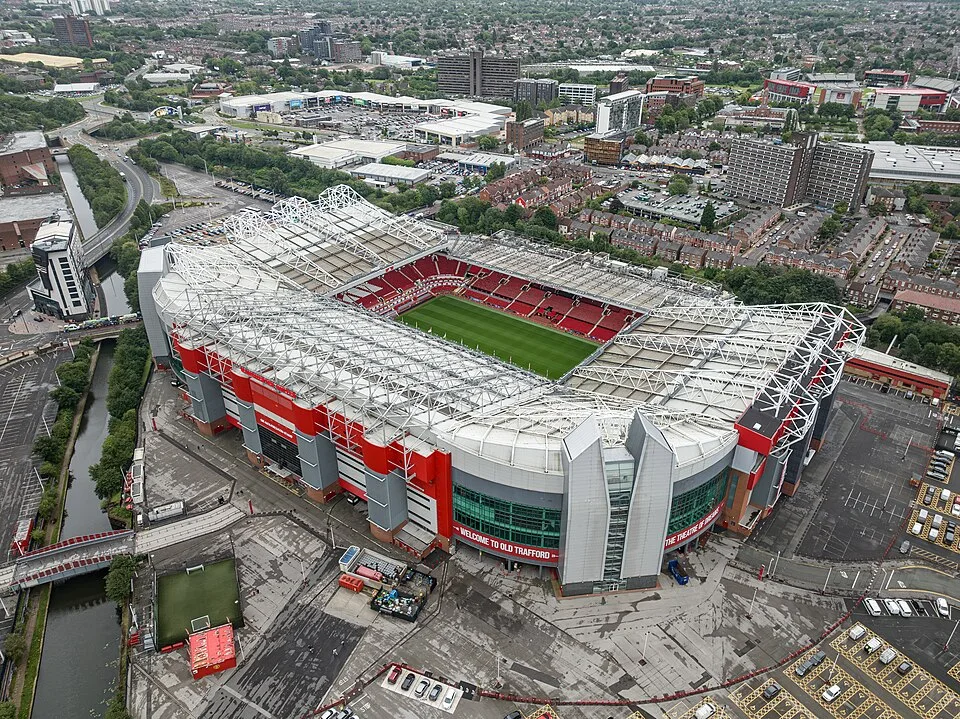
1910 opened Old Trafford beside expanding industrial Trafford—not village quaintness but freight psychology: trains, warehouses, and later motorway spokes feeding northwest England’s labour markets. Capacity ambitions tracked gate receipts through World War I interruption and 1939–1945 bombing damage that cracked stands; post-war steel and municipal optimism rebuilt the bowl while rationing still framed household kitchens.
Terrace cultures layered generation onto generation—Stretford End mythmaking, song repertoires imported from docks and Irish migration waves—until all-seater conversion rewrote acoustic physics after 1989’s Hillsborough report reshaped English stadium law. Modern expansions chase hospitality yield: executive tiers finance loan schedules while legacy supporters argue about atmosphere metrics nobody can invoice cleanly.
Munich 1958 and the calendar page February still refuses to skip
European competition turned glamorous—then catastrophic: the Munich air disaster (6 February 1958) killed players, staff, and journalists—Matt Busby’s rebuild became theological narrative inside Manchester storytelling. Youth graduates dubbed Busby Babes symbolised post-war optimism; their absence forced recruitment philosophies that later fed 1968 European Cup triumph at Wembley—proof grief schedules could still curve toward silver.
Anniversary television packages replay wreckage with reverent voice-overs; survivors’ testimonies belong to families first—club historians second. That sanctified February memory still arbitrates how outsiders criticise modern wage bills—supporters hear disrespect faster than tactical nuance.
Domestic television, Ferguson time, and export-brand football
Sir Alex Ferguson’s tenure (1986–2013) coincided with satellite football selling English weekends overseas—Premier League inventory turned Old Trafford into weekly appointment viewing from Jakarta to Johannesburg. 1999 treble mythology condensed decades of incremental squad building into single‑night highlight permanence; Ronaldo chapters added celebrity physics to wing play economics.
Post‑2013 cycles oscillated between rebuild metaphors and coaching churn—ownership structures, stadium debt discussions, and transfer-window theatre stayed permanently adjacent to scorelines in news indexes. Supporters’ forums treat board minutes like liturgy; neutrals treat United fixtures like volatility indices.
The derby is municipal zoning dressed as philosophy
Against Manchester City, family geography splits across colour lines—school gates, office carparks, wedding receptions—while broadcasters script blue‑versus‑red stories that flatten complex class histories. Against Liverpool, northwest labour mythology and European pedigree collide; against Leeds, older roses rivalry language still surfaces when schedules align.
Dates search bars autocomplete even when form tables wobble
Verify trophy totals against official club and UEFA sources—competition names evolve.
- 1878 — Newton Heath LYR founded among railway workers.
- 1902 — Manchester United name adopted after local investor takeover.
- 1910 — Old Trafford opens—stadium scales with civic industrial growth.
- 1945 — Matt Busby appointed—long-horizon academy identity accelerates.
- 1958 — Munich air disaster—club trauma and international mourning.
- 1968 — European Cup win at Wembley—first English champion in that era’s format.
- 1992 — Premier League founding—broadcast economics transform weekly football.
- 1999 — Champions League final comeback in Barcelona—treble mythology peaks.
- 2008 — Champions League title in Moscow—penalty theatre enters permanent clip rotation.
- 2013 — Sir Alex Ferguson retires—modern churn cycles intensify.
- 2020s — Coaching transitions, ownership headlines, partial stadium renewal debates—same stadium, faster news cadence.
Revenue beside followers—two instruments, one noisy orchestra
Totals below come from different snapshots: club revenue ties to 2024/25 reporting cycles in euros; follower totals aggregate official club accounts across major platforms using CIES methodology as of June 2024. One measures accounting periods; the other measures attention economies—do not merge them into vanity rankings.
| Metric | Value |
|---|---|
| Total revenue (€m, 2024/25 season, widely cited annual football finance surveys) | 793 |
| Combined social followers (millions, official accounts on Facebook, X, Instagram, TikTok—CIES June 2024) | 216 |
Trophies that landed while expectation compounded itself
United’s statistical reputation rests on stacked First Division / Premier League titles across Busby and Ferguson arcs plus repeated FA Cup chapters—European honours include European Cup / Champions League wins separated by decades of tactical fashion.
Old Trafford seating counts rank among England’s largest club bowls—tourism packages pair museum corridors with megastore throughput; digital audiences multiply kit launches regardless of league position.
- English leagues: multiple championship eras—from 1908 early triumphs through 1950s revival and 1990s–2010s Premier League dominance—always cite seasons against league archives.
- FA Cup: deep historic runs—final-day folklore feeds generational memory beyond analytics dashboards.
- European Cup / Champions League: 1968, 1999, 2008 headline eras—verify opponent contexts before comparing across decades.
- Worldwide audience: combined social scale reflects diaspora television decades predating TikTok-native youth fans—the snapshot table summarises that reach without pretending one season’s league finish equals brand decay.
- Stadium economics: ongoing renovation debates tie seat yield to debt schedules—sporting performance and facility finance remain partially coupled.
After the last whistle on paper
United is railway soot translated into satellite subscriptions—Newton Heath budgets ghost every finance headline about wage amortisation. Next summer’s midfield plan will age poorly on Twitter within weeks; Trafford trains will still deliver crowds because Manchester football rarely apologises for being loud.