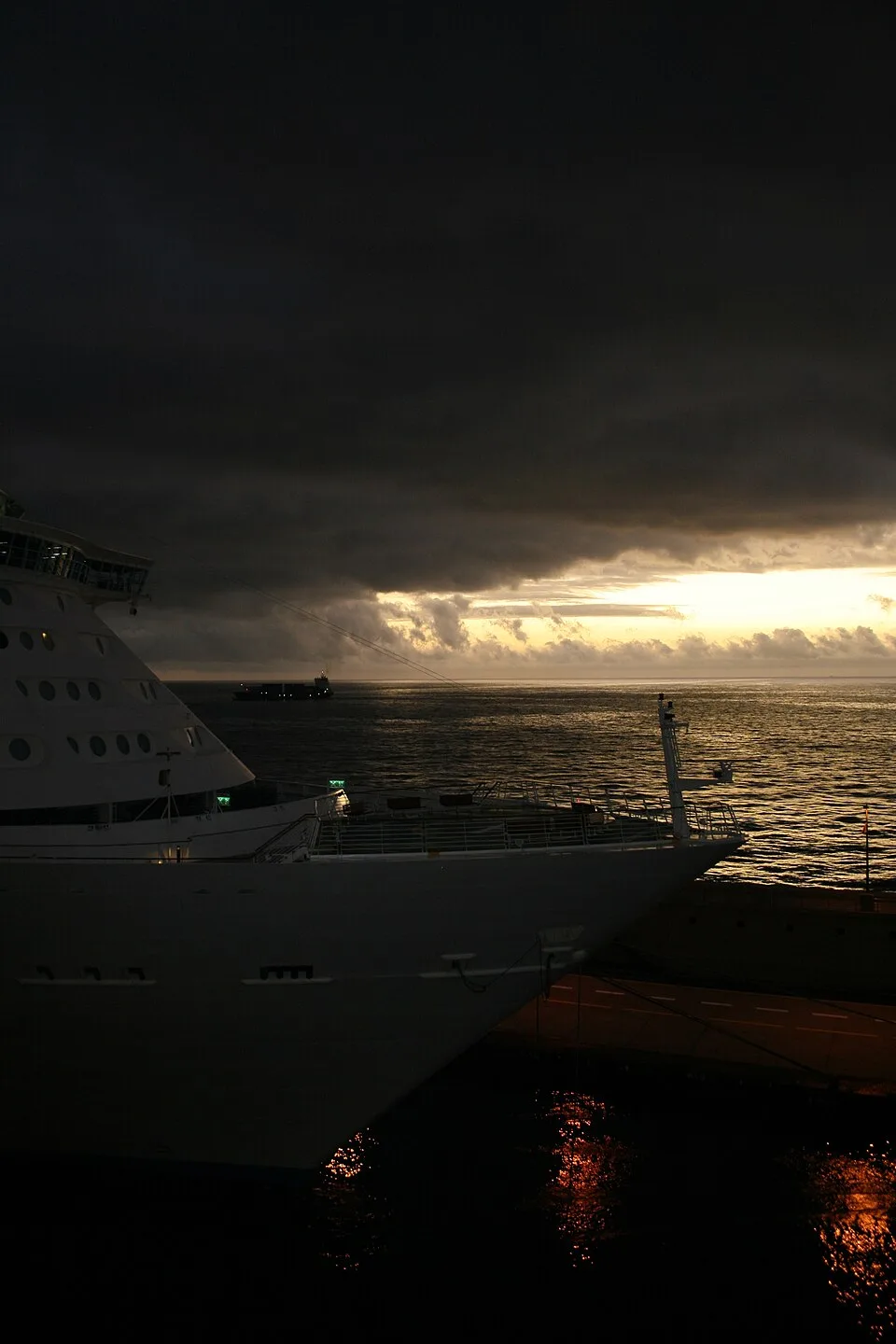
Why Tenerife became the evacuation hinge
After denied docking windows elsewhere and an Atlantic rerouting, expedition vessel MV Hondius reached waters near Tenerife on 10 May 2026, converting the Canary Islands into the logistical pivot where roughly 140–150 remaining travellers—crew and guests spanning more than twenty nationalities—could leave under coordinated medical supervision rather than dispersing ad hoc through commercial terminals.
What authorities described Sunday morning
Spanish health officials termed the choreography unprecedented, pairing navy-style shore boats with military-style buses whose seats were sleeved in plastic sheeting to minimise surface contact during airport transfers. Early statements stressed that everyone still embarked remained asymptomatic at inspection—a qualifier epidemiologists treat cautiously given hantavirus incubation windows that can stretch for weeks, yet operationally useful for prioritising immediate respiratory isolation thresholds.
Sequenced national waves rather than a free-for-all
Disembarkation followed nationality blocks rather than ticket class: Spanish citizens reportedly exited first via small craft toward Granadilla de Abona, continuing by sealed road convoy to Tenerife South for a government flight to Madrid and hospital quarantine. Netherlands, Germany, Belgium, and Greece passengers were bundled into a later wave sharing aircraft capacity; Turkey, France, the United Kingdom, and the United States waited subsequent slots. Officials cautioned evacuees would not debark until their assigned plane stood ready—an attempt to prevent terminal mixing that could recreate shipboard density on land.
The twenty-two British nationals
Headcounts circulated for UK travellers still aboard aligned with three crew and nineteen guests—twenty-two people total—expected to test before leaving the ship, ride cordoned buses roughly ten minutes to the airport, and board dedicated repatriation flights the same day as operations permitted. That figure sits alongside a wider British caseload already dispersed: some nationals evacuated earlier to tertiary hospitals overseas, others monitored after St Helena disembarkation, illustrating how UK risk managers must reconcile inbound charter logistics with tracing obligations on multiple Atlantic timelines simultaneously.
NHS intake plan on arrival in England
Briefings outlined an initial National Health Service reception corridor in Wirral, Merseyside, where returnees would undergo clinical assessment and testing during an approximately seventy-two-hour observation window before specialists decided whether home isolation or alternative housing offered sufficient containment. That staged approach mirrors hybrid strategies used when pathogens combine long incubation with psychosocial resistance to open-ended hotel quarantine.
Secondary reporting elsewhere debated longer voluntary self-isolation horizons for some returned nationals already flagged in tracing matrices—illustrating tension between conservative incubation math (six-week ceilings cited in global guidance) and NHS bed scarcity should mild cases crest synchronously.
Island politics and protest optics
Tenerife residents voiced anxiety—some organising visible protest—reflecting fear that global solidarity narratives crash against local tourism economies when infectious-disease theatre lands on municipal quays. Regional leadership tensions surfaced publicly earlier in the week when Canary politicians argued Madrid authorised arrivals without fully satisfying local information demands, a reminder that maritime disease diplomacy spans microbiology and electoral geography.
International risk framing versus headline fear
European public-health guidance continued classifying embarked individuals as high-risk contacts while maintaining that broader community danger stayed low—consistent with Andes lineage behaviour emphasising close-contact propagation rather than casual passer-by aerosol events. Still, the juxtaposition of luxury expedition branding with military buses fed cable-news spectacle likely to outrun genomic certainty about who infected whom.
Scientifically, the episode sits awkwardly between textbook rodent-reservoir lessons and shipboard social density: investigators still weigh shore excursions near Patagonian rodent habitat against prolonged indoor proximity once viral shedding began—dual hypotheses that determine whether future cruise itineraries tighten wildlife excursions, cabin ventilation standards, or both.
Operational tail: Pacific finale scheduled next
Spanish ministers outlined a deliberately sequenced final long-haul rotation—including Australia and New Zealand routing—for a handful of Asia–Pacific passport holders, acknowledging fuel-range and crew-duty constraints make that segment the logistically heaviest rather than the numerically largest.
Bottom line
May 2026’s Tenerife tableau turns MV Hondius from epidemiological mystery into customs-controlled mobility: nations reclaim citizens through militarised compassion while clinicians watch incubation clocks that operate longer than any minister’s weekend talking points. For British passengers, the story now bridges charter manifests and NHS intake capacity—a domestic stress test layered atop an already fragile acute-care spring. Dashboard watchers should track oxygen-capacity utilisation in coastal referral hospitals as much as flight manifests.