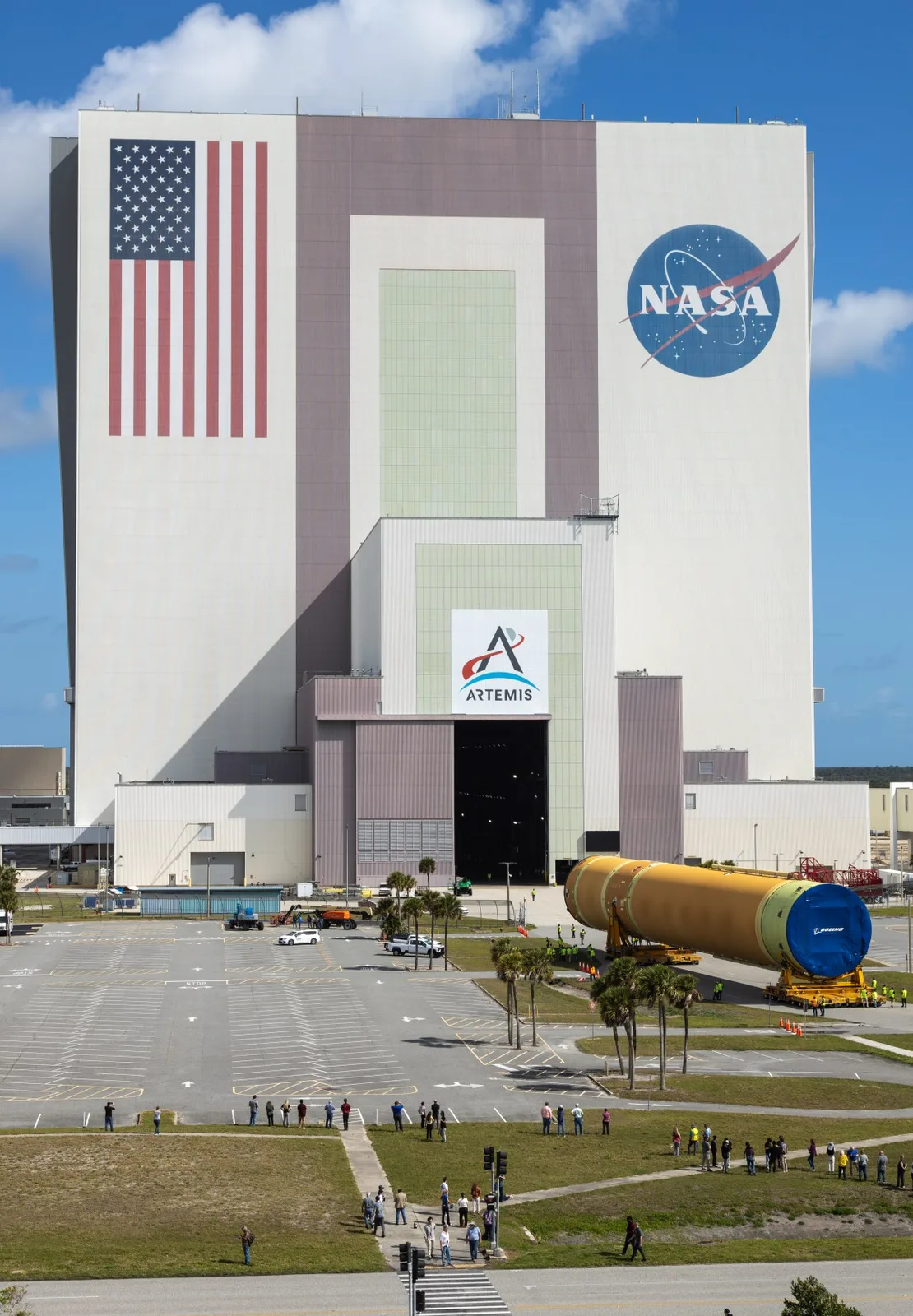
NASA’s public Artemis III materials no longer describe a straight shot to lunar sortie: the agency now markets the flight as a 2027 crewed low Earth orbit demonstration whose primary job is to prove that Orion can rendezvous and dock with commercial human landing hardware before Americans return to the surface on Artemis IV in early 2028. A detailed agency article posted 13 May 2026 and revised 15 May 2026 walks through stack changes, multi-company operations, and open decisions—hardware headlines from Kennedy Space Center in late April already showed the mission’s SLS core stage entering the Vehicle Assembly Building as planners lock the concept of operations.
What changed conceptually
The shift inserts a high-fidelity rehearsal closer to home. Instead of treating the third Artemis launch as the first Moon landing attempt, NASA now treats it as a systems-integration crucible: four crew members ride SLS and Orion, then exercise docking interfaces and mission rules against at least one—and potentially two—commercial lander pathfinders that would later evolve into lunar descent vehicles. Agency leadership argues the complexity rivals many deep-space profiles because launches, flight dynamics, and ground teams must stay synchronized across separate contractor stacks.
Rocket stack: spacer instead of a powered upper stage
One concrete engineering difference is replacing the interim cryogenic propulsion stage with a non-propulsive spacer that preserves the overall height and mechanical interfaces between Orion’s stage adapter and the launch vehicle stage adapter. Fabrication work is underway at Marshall Space Flight Center in Alabama, where barrel sections and rings were being machined ahead of welding when NASA published its May briefing. The spacer keeps mass properties and clearance envelopes representative of the eventual upper stage while acknowledging that this mission does not need that stage’s translunar burn role.
Why Earth orbit for a dress rehearsal
Circularizing Orion in low Earth orbit buys schedule resilience: NASA’s writers note that staying near the planet widens launch windows for SLS, the Starship-derived human landing system pathfinder, and Blue Origin’s Blue Moon Mark 2 pathfinder compared with forcing every partner onto a single translunar timeline. More opportunities reduce the odds that one supplier slip voids an entire campaign, a practical concern when landing systems remain deep in development.
Operations picture still in motion
Official copy stresses that many choices remain open. Astronauts could enter at least one lander test article, but which vehicle hosts which test is not finalized. Mission duration, science tasking, and the roster for training assignments are still being refined, as is how much interface risk reduction NASA will demand on Axiom’s AxEMU suit connections before lunar sorties. Communications planning is explicitly flagged as a work item because the flight will lean on near-Earth networks rather than the Deep Space Network architecture used beyond geostationary distances—NASA said it is asking industry for ideas to improve ground links and floated potential CubeSat rides hosted in Earth orbit as the concept matures.
What crews and hardware teams gain anyway
Even without a translunar leg, the mission lengthens crew time inside Orion relative to Artemis II, deepening life-support data. Docking mechanisms will see their first crewed end-to-end checkout, and controllers will rehearse how Orion, lander flight software, and ground procedures behave when more than one company is in the loop. NASA also intends to exercise an upgraded Orion heat shield on return, aiming for reentry profiles that future lunar-return trajectories may require.
How this lines up with the wider manifest
NASA’s March architecture explainer still frames Artemis II as the near-term cislunar shakedown, Artemis III as the mid-2027 Earth-orbit integration test, Artemis IV as the first South Pole landing in early 2028, and Artemis V as a late-2028 surface mission that begins laying groundwork for a sustained base. Standardizing SLS variants and rethinking second stages for later flights remain parallel threads; Artemis III’s narrower rocket configuration is presented as part of that standardization path rather than a one-off stunt.
Risks readers should keep in perspective
Multi-launch campaigns with human-rated vehicles are sensitive to certification pace, not just headline dates. Until NASA names a crew and publishes a day-by-day timeline, outside estimates of readiness should be treated as provisional. The May article itself carried an editor’s note that wording on spacer design was clarified on 15 May 2026—a small reminder that even descriptive press products are living documents while engineering reviews continue.
Bottom line
Artemis III is now explicitly a 2027 Earth-orbit integration flight: 4 Orion crew members, an SLS stack using a structural spacer where the interim cryogenic propulsion stage once sat, and rendezvous-and-docking practice with commercial lander prototypes that underpin later Moon landings. NASA’s May 2026 planning update fills in mechanisms—LEO phasing, comms alternatives to the Deep Space Network, heat-shield testing, and optional crew ingress into a lander—while leaving crew picks, duration, and hosted payloads to future releases. The national storyline is unchanged—return Americans to the lunar surface—but the stepping-stone moved closer to home before the 2028 landing attempt.