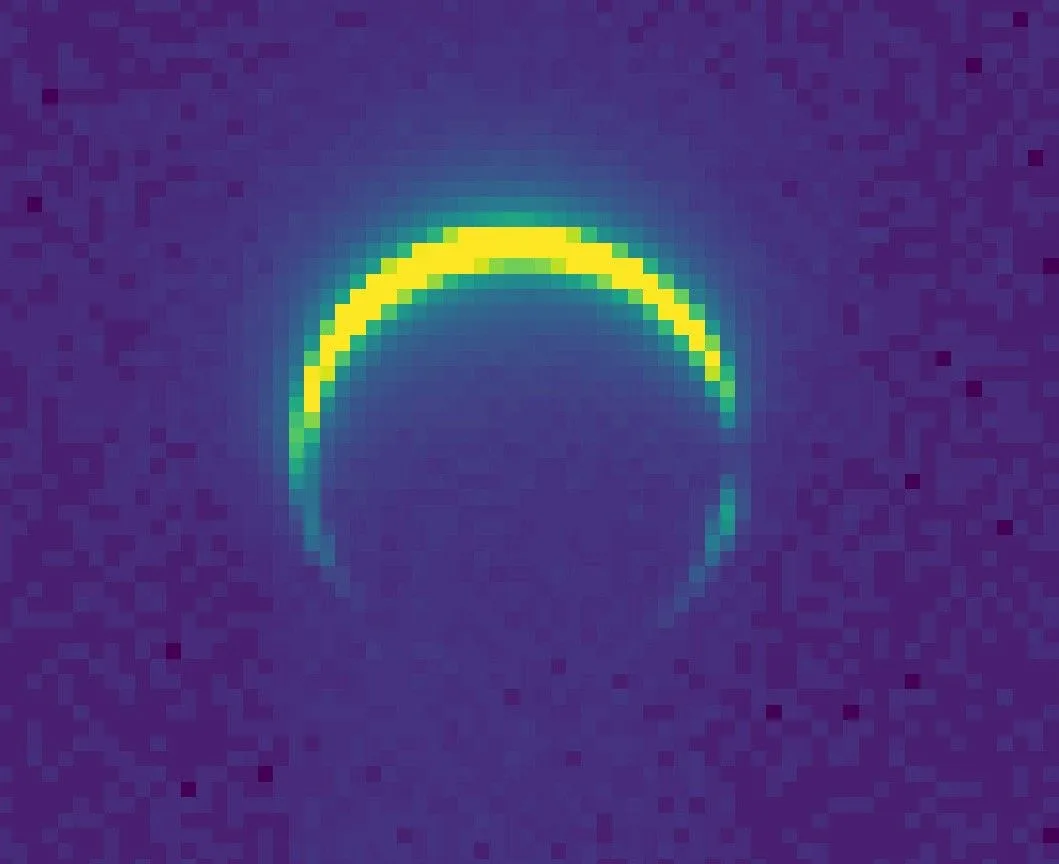
NASA’s Psyche spacecraft, managed by the Jet Propulsion Laboratory in California and bound for the main-belt object 16 Psyche, is executing its Mars gravity-assist flyby on 15 May 2026. Controllers expect closest approach at roughly 2,800 miles (4,500 km) above the surface while the bus is moving on the order of 12,333 mph (19,848 kph). The maneuver is not a stop at the red planet: it is a choreographed pass that steals a little orbital energy from Mars to shorten the cruise and tilt the flight path toward the 2029 rendezvous with one of the solar system’s most metal-rich large bodies.
Why bend past Mars at all
A gravity assist is best thought of as a momentum exchange with an entire planet: the spacecraft falls toward Mars, swings past, and leaves on a new vector with slightly different speed and inclination relative to the sun than it had on approach. Mission designers trade a few hours of navigation tension for megajoules of velocity change that would otherwise demand long burns of xenon on Psyche’s solar-electric thrusters. Principal investigator Lindy Elkins-Tanton, quoted in agency materials, frames the encounter bluntly: the pass exists mainly to speed the craft and re-aim it toward the asteroid, with instrument work as welcome bonus if power and timelines allow.
From launch in 2023 to a May 2026 bend
Psyche launched on 13 October 2023, riding a slow-building electric propulsion arc rather than a short chemical sprint. That architecture favors patient trajectory sculpting but still needs planetary leverage for plane changes toward the asteroid belt. The May 2026 window therefore sits roughly midway between Earth departure and late 2029 arrival operations at 16 Psyche, a ~173-mile-wide world thought to preserve clues about how rocky planets assembled cores before collisions stripped away silicate mantles in some cases.
Setting up the aim: a February correction burn
Teams executed a trajectory correction maneuver on 23 February 2026, firing thrusters for about 12 hours to refine speed and aim ahead of May. Sarah Bairstow, Psyche’s mission planning lead at JPL, said in a NASA posting that the flight computer had been loaded with the May activity timeline and that the pass would be the first in-flight chance to calibrate the multispectral imager on a target wider than a handful of pixels.
What the cameras will see—and why it looks odd
Because Psyche overtakes Mars from a high phase angle—roughly speaking, catching up on the night side with only a sunlit sliver visible—the planet first appears as a razor-thin crescent rather than the familiar rusty disk. Jim Bell, the imager lead at Arizona State University, told NASA writers that the geometry is awkward for vacation snapshots but excellent for calibration: extreme contrast exercises detector linearity, scattered-light control, and exposure sequencing the team will need when 16 Psyche fills more of the field of view. A 3 May 2026 colorized view released through the agency’s photojournal was acquired from about 3 million miles (4.8 million km) out using a 2-millisecond panchromatic exposure; even that short integration saturated parts of the crescent, underscoring how bright forward-scattered light can be when dusty air wraps the limb.
Bonus science questions riding on the pass
Operators plan thousands of imager observations during approach and departure. One long-shot target is a hypothesized faint dust torus fed by micrometeorite impacts on the moons Phobos and Deimos; if sunlight catches that debris at favorable geometry, processed stacks might reveal a ring-like glow. Separately, the team will run “satellite search” pointing patterns around Mars as practice for hunting moonlets near the asteroid later this decade. Other payloads get a workout too: a magnetometer may see the planetary field redirecting solar wind particles, while a gamma-ray and neutron spectrometer can track how the cosmic-ray background shifts through closest approach.
How controllers confirm the maneuver
Confirmation leans on the Deep Space Network radio links. Engineers watch Doppler shifts in the carrier as Mars tugs the spacecraft’s path; a successful assist shows up as the expected signature in frequency residuals compared to pre-flyby predictions. That measurement is mundane on paper but mission-critical: if the observed bend disagrees with models, downstream maneuver budgets for the cruise to 16 Psyche must be rebuilt.
Other Mars robots as cross-checks
NASA’s posting notes that Mars Reconnaissance Orbiter, Mars Odyssey, Curiosity, and Perseverance, together with the European Space Agency’s Mars Express and ExoMars Trace Gas Orbiter, can supply complementary imagery and navigation context during the encounter window. Cross-comparing spacecraft-to-spacecraft geometry helps validate pointing knowledge and radiometric ties—useful not only for Psyche but for any future campaign that threads multiple assets near the planet on tight schedules.
What success unlocks for the asteroid leg
If imager and spectrometer calibrations hold, operators retire risk before the hardest phase: matching velocities with a small body whose gravity is feeble compared with Mars’s. Better in-flight characterization of stray light, dark current, and pointing jitter translates directly into cleaner global maps and compositional strips once Psyche begins its survey of 16 Psyche’s ancient metal-rich terrain—still years away, but dependent on the geometry lessons learned during the May 2026 encounter window.
Bottom line
On 15 May 2026, NASA’s Psyche probe makes a ~2,800-mile Mars flyby at ~12,333 mph, trading a close brush with planetary gravity for speed and a plane change toward 16 Psyche while stress-testing cameras and particle sensors. Controllers already locked in a February 2026 correction burn; Doppler tracking through the Deep Space Network will nail the outgoing trajectory, and partner Mars orbiters and rovers add context from the other side of the sky. The headline science target remains the asteroid arrival around 2029, but this pass is where much of the instrument trust is earned.